
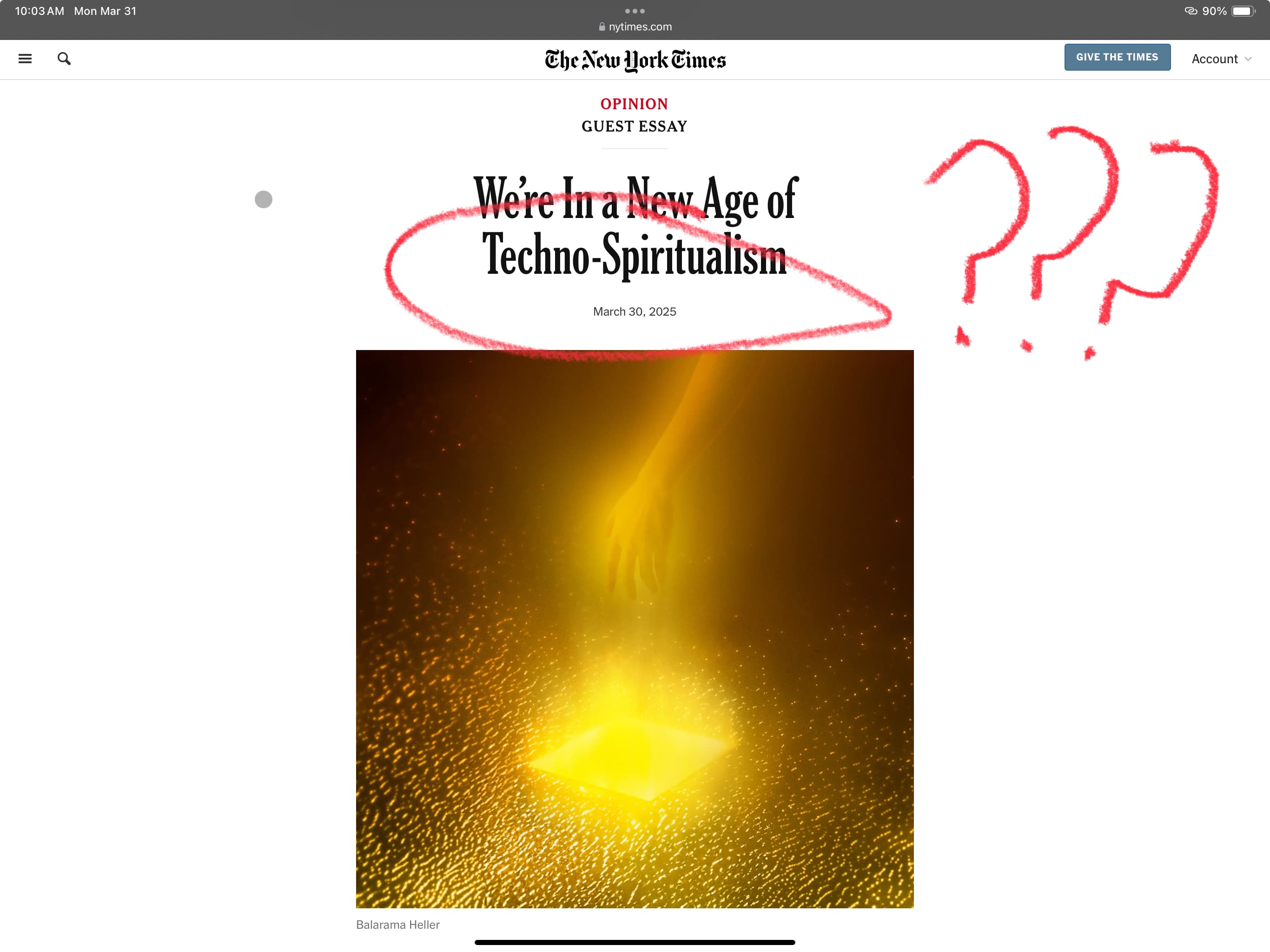
Exhibit A – the New York Times just published a piece about “Techno-Spiritualism”. What could this mean? I took the bait and clicked.
Quickly I realized this was about resurrecting dead people with AI. In other words, absolutely nothing to do with the exploration of mind and reality.
Very often, the exploration of mind and reality is exactly what “spirituality” means. More often though, it can mean religion, souls within a body, the afterlife, non-religious belief in divine power, or in this case, simulating a dead person with technology.
There is nothing necessarily wrong with these topics in isolation. The problem is how they are inadvertently connected with this ambiguous word. To anyone who is interested in “spirituality” or who might call themselves “spiritual”, they are knowingly or unknowingly implying a pu pu platter of contradictory topics.
Baby in the Bathwater
Among all things “spiritual”, there is one that stands out as totally uncontroversial: exploring our mind and reality.
Our mind, or consciousness, is the only thing we know for certain. I think therefore I am. It is the place we live, the interface between us and all existence. Not much controversy so far!
Also without controversy, there are aspects of our mind that are straight-up misleading or hidden from us.
Also without controversy, there are proven ways to explore this, which remain loyal to empiricism and the scientific method. In other words, we don’t need to believe in magic, doctrine, or supernatural authority, to gain profound insight into ourselves.
If this was all “spirituality” meant, there would be no issue…
But again, because the word can mean several other things, one either has to qualify every time they use it, or, accept the fact that their audience cannot know for sure what they mean. Even the greatest attempts to be precise may still alienate people who associate the word with dogma or woo.
Who Cares?
Can’t people use “spirituality” how they want?
Of course.
The problem is if we want to socialize about the very specific uncontroversial definition described above.
If we pay attention to consensus cognitive science, there are three points we can grant as truth:
- The mind is certainly misleading.
- This certainly causes suffering.
- There are certainly ways to overcome this.
These seem so ridiculously obvious, you would think it would be taught in first grade…
”Hey kids, we got this thing called science, it ain’t perfect, but it’s the best we got for knowing ‘truth’, and it says our minds are pretty messed up. Good news though, there are the ways you can avoid being hurt by it, that you can explore long into adulthood.”
Sadly this isn’t the case.
But even if we wanted to teach this, what would we even call it? “Spirituality school” ? You can see the chaos and controversy that would ensue with that suggestion.
“Self-Investigation”

Self-Investigation simply means taking ourselves apart to understand who we are. In doing so, we understand our minds, selves, and reality. We do this in accordance with empiricism and science.
This will not resolve the ambiguity of the word “spirituality”, but, for those of us who relate to this more precise definition, we have a way to talk about it with each other.
More on Self-Investigation here.


Leave a Reply