
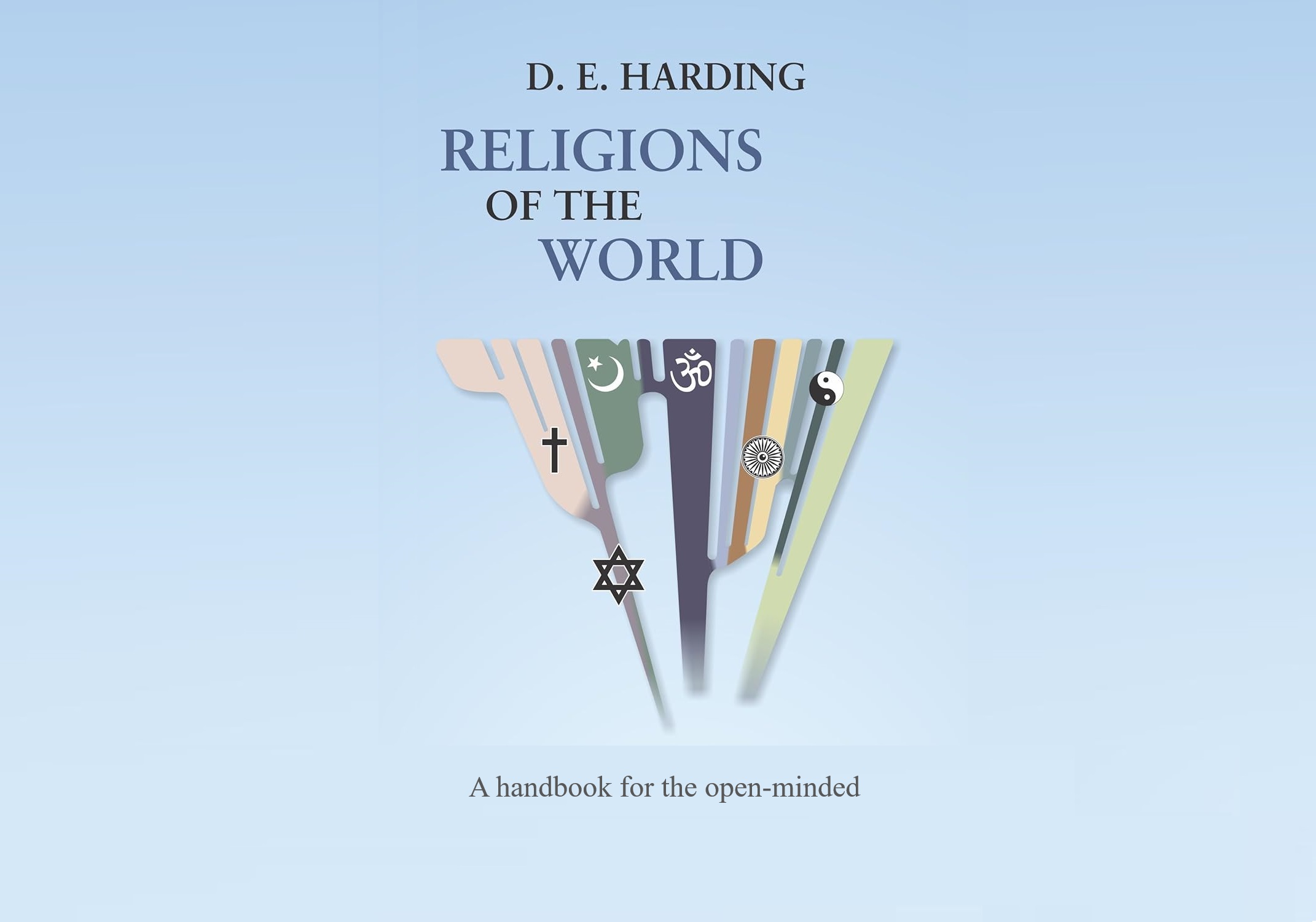
Who would ever compare religions? For the devoutly religious, they may be too convinced of their faith to care about others. For the ex-religious or casual atheist, all religion may seem irrelevant.
This book walks a middle ground. It allows us to see that religion, broadly speaking, is an imperfect conglomeration of poetry, psychology, morality, devotion, and rules for living. The emphasis of these themes varies from faith to faith.
Most persistently though, across all major faiths, is a recognition that we are part of something unknowable, and an suggestion to look inside ourselves – to know ourselves beyond what we tend to experience.
Religion aside, Douglas Harding argues this kernel seems relevant to every person alive.
Major Ideas
- Comparing religions is a modern privilege
- At the heart of major religions lies some form of mysticism
- Mysticism involves knowing ourselves and our connection to all things
- Science’s role in religious skepticism
- Science ultimately supports our fundamental mystery
The following are direct excerpts.
Introduction
One of the most universal of religious intuitions is a feeling that existence is utterly mysterious, a conviction that the ultimate reality or source of existence must be absolutely unknowable. At its very highest level religious experience isn’t knowing anyone or anything, but unknowing everything — a state of wonder and openness and clarity, which to the outsider might seem like mere emptiness. I don’t believe that anyone is entirely without religious feeling, though certainly most of us in the modern world neglect it or suppress it nearly all the time.
Religion in Two Sentences
Let’s attempt the impossible and put into one or two sentences the universal, highest teaching. It would run something like this: There is a reality which is indivisible. One, alone, the source and being of all; not a thing, nor even a mind, but pure spirit or clear consciousness; and we are that and nothing but that, for that is our true nature.
“Who Am I?“
If you have some life and enterprise in you, then surely you will want to examine what you really are, and where you came from and where you’re going, and what meaning your life can have. If you’re not content just to live a day – to – day, unreflecting, almost animal existence, but instead have the courage to look into the astounding mystery of yourself while you are still alive and able to do so, then you just can’t fail. Merely to ask yourself, genuinely and simply , that vital question “Who am I ?” is to change your life significantly; and it can start a spiritual process that will revolutionize it totally.
Comparing Religions: A Modern Privilege
Nearly everyone takes over and then passes down the beliefs of their parents. In the past this may have been natural . There was little means of comparison with other religions, and often no awareness that they even existed . But now, thanks to scholars who have translated the scriptures and teachings of the various traditions into our language, we do have a choice.
Hinduism
One
India is likely the original home of the idea of the absolutely One, of the God who is so much master of the world that in fact he is the world and everything in it. The Supreme Brahman of Hinduism is not a personal God.
[Poetry of Hinduism] shows admiration, joy and surprise that the universe is on the whole friendly and intelligent, and certainly very beautiful and vast and magnificent and mysterious.
Modern westerners are apt to think of ourselves as somehow tossed into a universe which is stupid, dead, and indifferent (in practice, hostile) to all we hold dear. We don’t really feel among friends or at home here in a place that’s ours and on our side and fundamentally like us. It’s more as if we accidentally got caught up in some huge, callous, idiotic machine. What is our evidence for such a view, what is our real reason for feeling like this? Why don’t we feel as the Hindus came to feel — that the universe and the human body as well as the human mind and religious feelings are all one, one organic whole, rather as you yourself are one organic whole?
The pious Hindu insists that the whole purpose of living is to make the most intimate contact with Brahman [the Absolute, the One]. How is this possible? To realize that we already are Brahman.
How Hindus Practice
How does the pious Hindu realize this lofty aim? First he must find a worthy teacher, a Guru whose claims to Liberation he trusts, and beg to be allowed to become his humble and obedient disciple. He must be prepared to reduce his possessions to a loin-cloth and a pot or two, and often be hungry and cold. He must listen reverently to his master’s teaching. He must absorb his master’s grace, that subtle and infectious atmosphere of radiance in which his own spiritual faculties may ripen. Above all he must, sitting in the lotus position, meditate in the master’s holy presence, with no holidays or time off, until the goal is reached.
On what does the disciple meditate, hour after hour, year after year, sitting beneath a forest tree or in a Himalayan cave with his beloved Guru? All sorts of profound and beautiful ideas? Not at all! In so far as he’s serious and successful in his task, he stops thinking, he thinks of nothing whatever! Or rather, of “nothing” or no-thing. He’s turning his attention from all thinkable things out there and back to the unthinkable One who experiences them all at the center.
This isn’t at all strange and difficult to see, but altogether natural and blazingly obvious, and what hides it from us is simply desire. Our attention is so fastened on the outside things which we love and hate and want to get hold of and to escape from, that we have no time for this.
Hinduism vs. Christianity
Perhaps this Hindu doctrine of the identity of God and the Self, appears most absurd and offensive to those of us who are convinced Christians. But the notion itself is quite familiar. Doesn’t the Holy Spirit (who is not a part of God, but God himself) dwell in the believer? In fact, doesn’t the Light light every man that comes into the world? “Not I,” says St. Paul, “but Christ that liveth in me.”
Buddhism
Buddhism began in ancient India as an offshoot of Hinduism. All the basic ideas of Hinduism, in one form or another, are taken for granted by Buddhists, and the goal of Liberation — Buddhists call it Enlightenment — is precisely the same in both religions.
Buddhism is a comparatively undogmatic, empirical, almost scientific religion, appealing to our common sense and critical faculties. Instead of telling us what to believe, as Hinduism and other religions are inclined to do, it requires us to take almost nothing on trust. We are to rely on no outside authority, but test everything as we go.
How Buddhists Practice
Pain and misery and unsatisfactoriness, or “Duhkha”, says the Buddha, marks all our experience, all human life, all existence in this world of space and time. Nothing is permanent. Even our joys are Duhkha, because they are fleeting and we know it.
The first step to be honest, stop pretending life is all right, and admit that it isn’t, that it never has been and never will be. The next step is to see that the cause of suffering is desire — craving, thirst, grasping. Obviously our desire isn’t in our circumstances but in ourselves, in our attitude to these circumstances.
Therefore, we must change our attitude, and get rid of the craving that produces suffering. The total destruction of desire is Nirvana, which is the state of Enlightenment which the Buddha arrived at under the Bo-tree.
Meditation
Observe your left thumb now holding the book, and notice how long you can look at it before some alien mental picture or idea obscures what you see. Isn’t it true that your attention is out of control, that you are the slave and not the master of your desire-ridden mind?
The heart of Buddhism is meditation, and the heart of Buddhist meditation is mindfulness. Mindfulness means clear and deliberate awareness of what’s actually to be seen or heard or felt here and now, without any thoughts intruding from outside, and without arousing any past memories or future plans.
The rewards of mindfulness can be immediate. The gates of perception are opened, and you start living in a brilliant and thrilling world of shapes and sounds and colors, of tastes and smells and textures, which you’d quite forgotten existed. But for Buddhism the chief purpose of mindfulness is to forge a really efficient tool out of the mind, and to turn that tool in upon oneself here at the center. In other words the highest mindfulness is mindfulness of the mind itself, awareness of one’s own awareness. Carried to the limit, this is precisely Enlightenment.
“No-Self“
Calming of your mind until it is freed from all bad emotions, all moodiness, all unsteadiness, and craving isn’t the final objective of Buddhist mindfulness. Its aim is Enlightenment itself. This isn’t merely a negative relief — the absence of craving — but a positive gain: the “opening of the Third Eye” which truly sees and which sees truly. What it sees is the absence of anyone here to crave things — no ego, no self, no-thing at all.
When you penetrate through outer appearances and come to the thing-in-itself at their center, you find just Emptiness; and this you must continually test for yourself by looking in at the Emptiness which you are.
Love and Compassion
Charity begins at home, so the first thing to do is to practice loving yourself. (This is neither easy nor unnecessary. Like much Buddhist psychology, it is profound: selfish people hate themselves, unconsciously.) Then, working outward, you direct your love in turn on your nearest and dearest, on the larger circle of your friends and acquaintances, on your community, and so on until your heart goes out to every creature in the universe.
Summary
In short, we may say that Wisdom, Compassion, and Practicality are the characteristics of Buddhism as a whole.
Confucianism, Taoism, and Zen
Confucianism
We can best summarize the teaching of Confucius by looking at his ideal man, his idea of what we should be like. Such a one is wise and human-hearted, characterized by honor and good breeding, generous to the less fortunate, reverent in the conduct of ritual, respectful to the Ancients, open-minded, just, not self-centered, not moody, courageous, public-spirited, loyal, without self-pity, moderate and not apt to run to extremes, ashamed to let his words go beyond his deeds.
Taoism
Confucianism was concerned with the mind that is the source of our behavior. Taoism is concerned with the primal simplicity that is the source of our mind, and of everything else. Taoism has no historic founder. The first and by far the greatest Taoist sage of whom we have definite knowledge, Chuang-tzu, was probably born some 150 years after the death of Confucius; and the most famous Taoist scripture the Tao Te Ching was probably not written down until a century after that.
The Confucian is concerned with what is right, but the Taoist is desireless, for it is outgoing desire that diverts attention from the Tao here at the centre: notice how he agrees exactly with the Buddha, whose Enlightenment, or Nirvana, is the ultimate extinction of desire. He has no opinions, because he stations himself in the Tao which, as the origin of every opinion, is absolutely impartial. He is idle, because any deliberate activity spoils the perfect, spontaneous natural working of the Tao. All he has to do is get out of the Tao’s way. He is yielding, humble, ever seeking the lowest place like water, and like water the Tao gently wears down the resistance of the hardest obstacles. He is childlike, even idiotic, because human intelligence is a kind of conspiracy against its own basis, against the Tao, complicating and distorting its perfect simplicity. He is original, because he is at the origin of all; unconditioned, unmechanical, unpredictable, and free, because there’s nothing where he’s coming from to limit him. His wisdom, his poise and peace and power, his strength which looks like weakness, all come straight from the Void, from the Emptiness at his centre, without being spoiled on the way by human interference.
Zen
Zen, the Offspring of Chinese Taoism and Indian Buddhism Buddhism filtered into China from India during the early centuries of the Christian era, and became firmly established in the sixth century, a thousand years after the death of the Buddha. Once it took on, Buddhism was further modified by the Chinese attitude to life — a practical attitude, not at all given to high flights of religious imagination.
Zen has always been primarily a religion for highly disciplined monks, a communal effort. There’s nothing slack about Zen. It is the toughest training in the world. The Zen monk is the commando in the field of spiritual religion.
How Zen Monks Practice
Let us take a look at a typical Zen monastery. The chief building is the meditation hall, where the monks sit cross-legged on two long low platforms, facing each other. Here they meditate for several hours a day, perfectly silent and still, with half-closed eyes.
What does the disciple meditate on? This depends on which Zen sect he belongs to (there are several) and the stage of his spiritual development. Maybe the abbot has given him a Koan to solve. A Koan is a sort of crazy puzzle.
The best-known Koan is of the Real or Original Face. According to the fourteenth century master, Daito Kokushi. It goes something like this: “Stop wanting anything, stop thinking, relax, forget all you imagine you know about yourself (including what you see over there in your mirror), look right here at the place where you are, and see what your face looks like now — the Face you had before you were born.”
However, the Soto school of Zen (which is the biggest of the Zen traditions in Japan nowadays) rejects the Koan method and any mere means to the Enlightenment which is already one’s own true nature anyway. That is what Za-zen, or sitting meditation, is all about — practising and establishing one’s present Enlightenment, not striving to achieve it in the future. It’s now or never!
The Way
Zen finds exquisite expression in the remarkable Japanese arts of judo, flower-arrangement, archery, swordsmanship, painting, and the theatre. At its best, the practice of each of these arts under a qualified master is a true Way. Anything we do, from breathing to ruling an empire, is potentially a Way. In fact, probably the right Way for each of us is in some respects our own and unique, and we have to find out for ourselves what precisely it is.
Enlightenment is the very opposite of absent-mindedness. It is being present. It is perfect Presence of “Mind”— where “Mind” sees Itself.
Eastern vs Western Religion
[Eastern: Hinduism, Buddhism, Taoism, Zen]
[Western: Jadaism, Christianity, Islam]
What a religion is like depends on what its God is like, and what its God is like depends on where he or she or it is located. In practice, I find that there are only two real possibilities — the nearest and the farthest locations [Eastern], the most accessible and least accessible stations [Western]. Western religion as a whole comes down on the side of the deity’s over-there-ness and not his right-here-ness, and this is particularly true of the father of Western religion, namely Judaism.
Judaism
Christianity, we may remind ourselves, was founded by a Jew and began its life as a Jewish sect; it took for the greater part of its sacred canon the Hebrew Bible — renaming it the Old Testament. Of course Christianity grew up along its own lines, reacting as children do against their parents. But its ever-renewed attempts to cut itself off from the parental stock are as absurd as they are impossible.
Judaism insists on a biblical God who has a special relationship with the Jewish people but who is also the God of all humanity and of all beings, and it rejects every sort of nature-worship, pantheism, polytheism, and idolatry.
Yahweh [God] first appeared to the Hebrews as a tribal deity among rivals, but early in Jewish history he came to be viewed not as the chief among many gods, but the one and only true God, sole creator and sustainer of the cosmos. We have seen that in India, too, the idea of the One God took over, but there he soon ceased to be merely or mainly transcendent; his truest home was discovered to be right here “within” us. He became God immanent. Not so for the Jews, who to this day remain devoted to the God “without”.
How Jews Practice
[The Jewish God] is interested in our outward behavior rather than our inner ideas and feelings, in ethics rather that spirituality. For the observing Jew this means carrying out meticulously as an individual, in the family and all its relationships, in business, in communal rites and in great seasonal festivals, God’s will — all as laid down in the sacred writings and in the commentaries which clarify and apply them. Virtually every aspect of human life is covered — diet (the list of what the Jew may and may not eat is long and complex), cookery (including what utensils may be used for what kinds of foods), daily prayer (how and when to pray and what to say and what to wear while praying), how to keep the sabbath, the treatment of animals, the details of personal hygiene, and so on and on.
This saves the otherwise dull and insignificant daily round from triviality and makes it meaningful and ennobled by linking it at every point with the power back of the world. The damaging split between the sacred and the secular is healed—or rather, is prevented!
One of the handicaps of having so many rules to live by is that it’s hard to avoid breaking some of them most of the time. A modern liberal or non-observing Jew does in fact ignore all but certain basic requirements of the Law — such as circumcision. As for the orthodox or observing Jew, he could well claim that a God who makes no difference in the detailed conduct of our lives is no God at all.
Jewish Mysticism
The large mystical collection known as the Kabbala proclaims the presence of God in oneself and in all things. Writing in Spain in the eleventh century, Moses Ibn Ezra is quite explicit: “Within me is the Lord.” Even more to the point is his predecessor Ibn Gabirol: “Thou art the soul of my soul.” And here are two Hasidic sayings: “By his works within me, I know the One”.
If in the end this religion comes around to the insights we have already discovered in other and Eastern religions, what (if anything) is there in this one which merits our serious attention?
Christianity
It is very difficult to attribute to Jesus any quite new insight or realization — one that wasn’t around in some form at the time in the Greco-Roman world or in Judaism itself.
Basic to Christianity is the faith that Jesus is the Son of God, the Messiah or Christ, the savior of the Jews and all humankind. God so loves us all that he comes down from on high and is born a squealing baby in the most deprived and sordid circumstances imaginable (how we romanticize that stable!), and suffers every heartbreak and humiliation and physical pain that humans are capable of.
For the first few years the Christian community, based in Jerusalem, was a Jewish sect — Jewish in its membership and practice.
Gnosticism (Christian Mysticism)
A gnostic is one who claims secret knowledge (gnosis) of ultimate things. In particular, the term is applied to a loose collection of “heretical,” more-or-less Christian sects that flourished through the first three centuries of the Christian era.
The gnostic finds God within, here and now at the very center of his universe, and accordingly becomes his own final and absolute authority on all the questions that really matter. He finds salvation in self-knowledge. This self-knowledge is described as the uncovering of an inner clarity and brilliance, so that instead of finding within himself the dark opacity of corruptible flesh, he finds a pure and steady light, luminous enough to light up the whole world. And that Light is the inside story of all things.
Jesus said: “If those who lead you say to you ‘See, the kingdom is in the sky’, then the birds of the sky will get there before you. If they say to you, ‘It is in the sea’, then the fish will precede you. In fact, the kingdom is within you.”
Summary
Christianity is a tree with many branches. Through self-loss the realized Christian gets down to the root of it, to the Mystery that is hidden in darkness. And because he (or she) gains that root, becomes that nourishing root, he becomes also the wide-spreading tree with all its variegated leaves and fruit. Ultimately he has no preferences, no personal opinions. He no longer picks and chooses among the innumerable sects and doctrines and practices of Christians. Because he rests in their common Source, he is it all, and he is free of it all; and it is all very good indeed.
Islam
We now come to Islam, the religion founded by the Prophet Muhammad and his Muslim followers. In its basic attitude, Islam belongs to the Western group of religions, along with Judaism and Christianity, though during the course of its spread East and South it has naturally taken on a more oriental look.
The key to Muhammad lies in his message rather than his life. For Muslims, Muhammad is the Rasul, the messenger or emissary of the Almighty One. Jesus declared God’s love; Muhammad declared God’s absolute majesty, transcendence, inscrutable power.
The God of Muhammad is Allah the Most Great, and Muslims are His abject slaves. Islam means submission, and Muslim means the submissive. There it all is, in three words: surrender to God.
Allah is not nearly so “personal” or “human” as the God of Christianity: He is too great to fit into the little niche we design for Him. So it is quite inappropriate to bother him with our petty worries or to pray to him for favors of any kind. We can only plead humbly for mercy, forgiveness, and guidance. To the Muslim, prayer is essentially an act of submission and surrender.
Divine majesty and idolatry are the main themes of the Koran. There is not very much else, in this large collection, which need detain us. A great deal of it has clear parallels in Jewish and Christian scripture. Regularity in prayer and fasting; attendance at public worship; almsgiving; refraining from bribery, gambling, usury, pork-eating and alcohol; practicing the common virtues such as honesty, industry and kindness; going at least once on pilgrimage to Mecca — such are the duties of a Muslim. It is a religious obligation to fight in the holy war against the infidel, a category from which Jews and Christians can be exempt as people who have a scripture and are non-idolaters. The good Muslim is rather like a Christian puritan, except that he has less objection to sex. There are repeated warnings of God’s wrath, of the day of judgement, and of the hell-fire which awaits the wicked — and particularly the infidel who rejects Islam.
How Muslims Practice
A Muslim is required to pray five times a day — at dawn, mid-day, mid-afternoon, sunset, and bedtime. Wherever he may be, he spreads his prayer-mat, faces the holy city of Mecca, and performs at least one Raka. A Raka consists of eight separate acts of devotion, each with its own prayer and posture.
Like Christianity and Judaism, and unlike most Eastern religions, Islam is congregational: public worship is an essential part of it. Communal prayers are held in the mosque on Fridays and on fast days throughout the year.
Islam, particularly in its public worship, overcomes mere individuality, and helps a man to transcend himself. And when the Prophet preaches Jihad, or holy war against the infidel, with promises of a delightfully luxurious paradise for all Muslims who are killed in battle, it is scarcely surprising that his battles are won. Prayer turns the battle and surrender inward as well.
Sufism (Islamic Mysticism)
“When I looked at myself, I saw myself no more.” – Rumi
The reciting of poetry, the playing of music (Ravel’s famous Bolero is taken from the Sufis), singing, and dancing—these aren’t so much useful accessories as joyful expressions of the Sufi’s God-filled life.
Sufism, so utterly unlike Zen in its style and mood, is in its own way as effective a discipline. Both have turned out many truly Enlightened Seers, and some in our own time. This is what one of them, the , who died in 1934, has to say:
“You are like a mirage in the desert, which the thirsty man thinks is water; but when he comes up to it he finds it is nothing. And where he thought it was, there he finds God. Similarly, if you were to examine yourself, you would find it to be nothing, and instead you would find God. That is to say, you would find God instead of yourself, and there would be nothing left of you but name without a form. This is true Islam, the ultimate submission; it is also, in a nutshell, the message of all the Awakened.”
Mysticism
The astonishing fact is that, if you push any genuine religious insight far enough, it will end as mystical experience of the very highest kind. All roads lead Home. Mystics claim (though non-mystics would hardly agree) that unmystical religion is simply religion unaware of its own implications, undeveloped.
Science
“How besotted and contemptible seems every little sentimentalist who comes blowing his voluntary smoke-wreaths, and pretending to decide things from out of his private dream! Clifford writes: “Belief is desecrated when given to unproved and unquestioned statements for the solace and private pleasure of the believer… If a belief has been accepted on insufficient evidence, the pleasure is a stolen one… It is sinful because it is stolen in defiance of our duty to mankind. That duty is to guard ourselves from such beliefs as from a pestilence which may shortly master our own body and then spread to the rest of the town… It is wrong always, everywhere, and for everyone, to believe anything upon insufficient evidence.”
– William James
The history of science throughout the past 500 years is a tale of religion’s determined resistance to every big step forward.
Christianity, for example, was firmly earth-centered. It looked upon our earth as the all- important nucleus of the physical universe, the hub around which the sun and all the stars revolved daily. And of course this was the only appropriate setting for God’s great plan of salvation, including the birth of His only-begotten Son as a baby in Bethlehem, his crucifixion at Calvary, and his ascent through the clouds into Heaven. No wonder the Church scarcely welcomed the discovery that our earth isn’t the center of the universe; nor the later, discovery that neither our sun, nor even our galaxy, can claim that unique distinction.
The task of reconciling traditional religion and modern science becomes still more awkward when we turn to the origin of life and of the human species. No doubt most educated Christians and Jews take the Garden of Eden story with a pinch of salt.
A religious orientation built on the rather flattering belief that God created man specifically and suddenly, in His own image, is bound to resist the discovery that man is an animal. And every one of us, whether religious or not, is bound to resist the further discovery that he or she, in his or her own lifetime, has been the inferior of that fly crawling on the window.
The physicist says that this seemingly solid body of mine, when closely looked into, is mere energy-filled space, as void as the sky. I disappear at dose range. Our bodies that they are “really” cells, and the cells are “really” molecules — and so on, until we are reduced to a cloud of inscrutable particles, to energy- filled space, to the unknowable. All that goes on in the world — love, pain, music, color, sports, stars, science, religion, trees, animals, humans, your reading this book — all is somehow contained in, or at any rate somehow emerges from, this infinitely mysterious substratum.
Making the struggle still more unequal, the social sciences and psychology are pressing the attack home. We can now trace the development of religious ideas from their crudest beginnings to their most recent and exalted refinements, and see the whole process as determined largely by climate, and economic conditions, and social stresses.
Still worse for our religion, if not quite fatal, is the alarming fact that our beliefs are determined by our chemistry. The contents of test tube A, injected in my arm, will in a few minutes produce glorious visions of heaven, and perhaps religious experience of a really high order. The contents of test tube B will produce the opposite effect, and send me straight to hell. Doesn’t this make nonsense of all our cherished spirituality?
No wonder so many honest people are anxious to bury religion and be done with it. All the same, it’s customary at funerals to say a kind word over the corpse — especially if it’s your mother’s! Christianity is the parent of Western science.
If we think that this whole approach is altogether too modern and unpoetic and science-ridden, and nothing much to do with what is religious and holy, we can go back thirteen hundred years to the Surangama Sutra of Mahayana Buddhism:
“I realized the Essential Nature of my body and mind, that it was like the flux of the oceans of fragrance surrounding the Isles of the Blessed. I came to realize that I had all along been throwing the broken shards of my thoughts of personality into the pure limpidity of my Essential Nature.”
Or, we can go back nearly another thousand years earlier, to the Dhammapada perhaps the most famous scripture of Theravada Buddhism:
“Knowing that this body is like froth, knowing it is of the nature of a mirage: breaking the flowery darts of Mara, the disciple will go where the King of Death will not see him.”
Conclusion
Strictly speaking, I have finished my job. As your host, I have done what I promised, and introduced you to the great religions. It is for you to weigh them up and test their teachings and make your own friends among them. The real conclusion of this book must be yours not mine.
My bias is not in favor of any one of great religions, but in favor of one aspect of them all — the mystical aspect. It seems to me to be all-important. Most other writers do not agree. Though many writers on religion agree that we must come to terms with science, few find in it (as I do) immense religious inspiration. What science tells me about myself — body and mind, and at all observational levels — I take to be a religious revelation.
Books and experiments are only means towards an end, which is self-knowledge. The purpose of our study is to introduce us to ourselves as much as to anyone else’s ideas and beliefs.
We begin to find out what we feel, what we think, and above all what we are, by reading and listening to and responding to other people and by testing their pronouncements. They oblige us to consult our own minds and hearts. And this is the really important thing, the final test. We are thrown back on ourselves, on the deeper intuitions that arise when we stop relying on the experience of others and stop letting them define and classify us.
“Who Am I?”
What do I want out of life? What do I suppose I’m here for? I want to find out what I am, that’s all. It seems too good an opportunity to be missed. To be born a human being, to exist at all, and not be interested — what a waste that would be! Here am I, my own specimen; inquirer and what’s inquired into, done up in one handy package. Here am I a complete mystery to myself, and a convenient sample of that total mystery, the universe.
Anything in religion that science can destroy, science should destroy, and good riddance! Science peels the onion of its dried-up skins, leaving intact only the nourishing core. When it shows how everything about me is conditioned, that my feeling and thinking are crooked, that my cherished opinions and lofty religious convictions (or anti-religious ones!) are the product of my body’s chemistry, and my parents’ attitude to each other and me, and of my age and income and education and race, and of I don’t know what else — then I give up!
This is the last straw, the breaking point, the end of all my pretensions. This is the ultimate and the hardest lesson, the final truth about myself — a bitter truth indeed. Nothing about me can be relied upon. Everything fails me, everything! Everything out there, from these hands and that little man over there in the mirror, to the sun and the sky and the universe itself, with every thought and feeling and quality it contains — everything is changing, dependent upon other things, out of my control, suspect, corrupt, not true, doomed. Everything about me and around me lets me down.
Only what is not about me or around me, but is me, can be relied on. Only what’s here will never let me down. This alone is permanent, free, eternal, unchanging. It is Nothing, Emptiness, mere Clarity. Yes, but it is a Nothing with a difference — a Nothing that’s aware of itself as nothing, and as Everything! This am I!
Full Book
Reflection
All of this raises an important question.
Leave a Reply