
Author: Josh Wagner
Two weeks ago I attended a week-long, silent meditation retreat at the Insight Meditation Society (IMS) in Barre, Massachusetts. Co-founded in 1975 by Joseph Goldstein, Jack Kornfield, and Sharon Salzberg, IMS was one of the first meditation retreat centers in the West, and offers retreats in a variety of formats, timescales, and pay scales throughout the year. This was my second time attending their Insight Meditation Retreat for 18 – 32 year olds and I really can’t overemphasize how profound of an experience it was.
Settling in
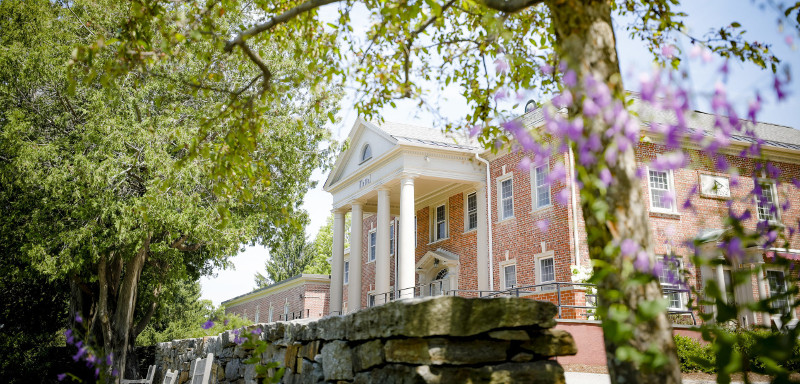
Upon first arriving, I pulled up to the white-pillared entrance to IMS – a former Catholic monastery situated in the serene countryside of Western Massachusetts – and was instantly greeted by familiar faces. One of the best things about going to a retreat center, especially one where people return year after year like IMS, is that you get to build community with others on the path of looking inward. After talking for a few hours with old friends and new ones, the ring of a bell signalled us to gather in the meditation hall, and the start of noble silence. Noble silence means voluntarily refraining from using technology, speaking, reading, writing, and (as best you can) even making eye contact. That even means no journaling or reading, the idea being that writing and talking can be a highly conceptual endeavor, thus making it more challenging to merely observe the workings of the mind rather than engaging with them.
So, the retreat was underway and the next 6 days looked about as follows:
- 5:15 – Wake up
- 5:45 – Sitting Practice
- 6:15 – Breakfast
- 7:15 – Service Practice
- 9:15 – Sitting Practice with instructions
- 10:00 – Walking Practice
- 10:45 – Sitting Practice
- 11:15 – Walking Practice
- 12:00 – Lunch
- 1:30 – Sitting Practice
- 2:00 – Mindful Movement
- 3:00 – Sitting Practice
- 3:30 – Walking Practice
- 4:15 – Dharma Talk
- 5:00 – Dinner
- 6:15 – Sitting Practice
- 6:45 – Walking Practice
- 7:30 – Metta Sitting Practice
- 8:00 – Metta Walking Practice
- 8:45 – Sitting Practice
- 9:15 – Sleep
It’s a lot, I know, and trust me there were times when I wanted to crawl out of my skin with boredom. But in my experience having such an isolated container for practice really helped me see the workings of the mind front and center. Over the course of the retreat, the mind played many roles, from gracious host to terrorizing cellmate. But through both the pleasure and the pain I found powerful insights about the way the mind was shaping my reality.
Skepticism
“History is not lacking in either religions or prophets, even without gods. He is asked to leap. All he can reply is that he doesn’t fully understand, that it is not obvious. Indeed, he does not want to do anything but what he fully understands.” ― Albert Camus, The Myth of Sisyphus
For the first three days of retreat, the majority of my mental energy was spent fighting on the front of skepticism. I found myself conjuring up elaborate narratives spanning from how the people around me were all delusional to how meditation was just a form of subconscious brainwashing to make people feel better. At the same time, I recognized firsthand the profound way meditation had richened the quality of my existence, and I acknowledged the many people I admired and respected who defended the practice.
The real rub was where the practice and subsequent way of living seemed to conflict with my upbringing. Having been raised in a military family of suburban America, the culture of Protestant work ethic, pragmatism, and fierce loyalty holds a certain nostalgia of childhood and family. Despite having seen firsthand the limits of such a worldview and having since become open to exploring others, I wasn’t ready to throw the baby out with the bath water. My skepticism refused to let me accept either view fully, however, and so I was stuck in a limbo-land of ambiguity.
“Tiger got to hunt, bird got to fly;
Man got to sit and wonder ‘why, why, why?’
Tiger got to sleep, bird got to land;
Man got to tell himself he understand.”
― Kurt Vonnegut, Cat’s Cradle
Being in that place of unknown was painful, and the craving for one absolute truth about the nature of life was so strong that I couldn’t quite give up my quest for answers. I just need to sit with these questions a little longer, I thought, and then I’ll figure out which way of living is “right” and from there everything will fall into place.
The thinking process came in waves. First, there was the chaos and anxiety of not knowing; the endless wrestling with points and counterpoints given an added punch by impending deadlines in my work, personal, and social life. Next, after much struggle, I would arrive exhaustedly at the still waters of decision, feeling on top of the world and finally at ease. Finally, just as I was beginning to feel confident in my certainty, the scale started tipping at the introduction of a creeping doubt, and suddenly I was hurtling into the pit of the unknown, right back where I started.
That process repeated over and over again those first few days, and I was stuck in a painful teeter-tottering between absolutes, with the gripping anxiety of the ticking clock twisting my stomach into a pretzel.
Breakthrough
“To learn which questions are unanswerable, and not to answer them: this skill is most needful in times of stress and darkness.” ― Ursula K Le Guin, The Left Hand of Darkness
Relief finally came two-fold. While existing in the container of retreat and not having anything else to occupy my time was incredibly painful at times, it was through being in such close proximity with the struggles of the mind that I finally found relief. After wave and wave of rumination, I finally came to the realization that I just couldn’t take it any longer, and that if I didn’t have the answers I would simply have to wait until I had more information. This realization was unsatisfying, but I simply didn’t have the mental energy to engage with the mind any further.
It was in this moment of letting go that I finally caught the mind making a fool of itself, spinning for the sake of spinning, and leading me again and again into a deep hole in the sidewalk. Almost like clockwork, the mind would dredge up all the same old arguments, fears, and doubts that never failed to get me going. But now, seeing them for the nth time and having lost all patience, it was clear that they were made up with no real basis in reality and completely out of my control.
Loosened from the grip of the mind, I was finally able to really engage with the practice of meditation, receiving the physical sensations of my body and accepting whatever arose. When the mind would posit a thought, I simply observed compassionately but refused to engage, addressing myself internally almost like a child with a “we’re not going to do that right now.” My practice became interesting, easeful, and important.
The Unexplainable
“In the midst of winter, I found there was, within me, an invincible summer.” ― Albert Camus, “Return to Tipasa”
Soon after acquiring this new orientation towards my experience and the practice, something transpired that I can’t entirely put into words. I can’t even say when it started or stopped, but rather, almost like a daydream, simply that it happened.
It was Tuesday night, the sun was beginning to set, and I was walking barefoot on the paved road in front of IMS. I was receiving the sensations of each foot lifting and pressing into the warm asphalt underneath. Thoughts would arise, but my attention was so engrossed by the feeling of my feet on the ground and the sun on my skin that I was able to just feel.
Suddenly, I found that I was enveloped by a deep sense of pure joy. I was warmed from the inside out with a full-hearted appreciation for how miraculous each and every moment was, and the world seemed more crisp and vivid than ever before.
“The moment was all; the moment was enough” ― Virginia Woolf, To the Lighthouse
It wasn’t that my particular circumstances were exceptionally pleasurable, because I had spent many an evening outside feeling good, but not like this. This was something bigger, transformational, a complete shift in my orientation towards the world where each moment felt like an infinity and everything was perfect just the way it was.
Whether it was a product of a shift from left-brain to right-brain dominance, a relaxation of the DMN, a harmonization of predictive processing and sensory input, or something in between, I’m not sure. What I do know is that it was one of the most profound and meaningful experiences in my life to date and that it helped me appreciate the true sanctity of life here on earth.
Boredom
“When Charles came to the Bertaux for the first time, she thought herself quite disillusioned, with nothing more to learn, and nothing more to feel.” ― Gustave Flaubert, Madame Bovary
What’s crazy is that despite having such a powerful experience, it only took until the next morning for me to be back to my same old thought patterns. I still held the wisdom that wrestling with life decisions wasn’t really getting me anywhere, and so I didn’t mess with that, but, without that battle, boredom crept in. Life seemed slow, uninteresting, predictable. I wanted a hit, a binge, a rush; some diversion from the stifling banality of the ticking clock. I couldn’t think of anything that really seemed worth doing, and when I thought about having to leave retreat, go back to work, and deal with the banal struggles of day-to-day existence, life felt like a chore.
I knew in concept that my prediction about what the future would look like was just another pattern of thought, and that the infinite presence and beauty of my experience just the day before undermined the banality of such, but I couldn’t shake it. So I was stuck there, disappointed and dreading what felt like the inevitable, unable to find a way out.
“Maybe dullness is associated with psychic pain because something that’s dull or opaque fails to provide enough stimulation to distract people from some other, deeper type of pain that is always there…surely something must lie behind not just Muzak in dull or tedious places anymore but now also actual TV in waiting rooms, supermarkets’ checkouts, airports’ gates, SUVs’ backseats. Walkmen, iPods, BlackBerries, cell phones that attach to your head. This terror of silence with nothing diverting to do.” ― David Foster Wallace, The Pale King
Thanks to experiencing the profound effect of a shift in one’s conscious experience firsthand as well as years and years of trying to fill the void with various vices, feeling better would mean changing my perspective on the world rather than the circumstances of it. So, I pushed myself towards the practice, desperately trying to outrun the boredom and return to that place of infinite interest and presence. I tried with all my might to remain completely still, keep all attention on the breath, and not get lost in thought for the entirety of each sit. The more I pushed myself, however, the more frustrated I became with my inability to “do it right.”
I desperately sought to return to the world of infinite interest in the pleasant moment, but as I sat and again and again urged myself to return to the breath, I only became aggravated. Time passed slowly for two days, as I fought the sorrow of life’s dullness and the pain of self-discipline.
The Will
“We cannot change anything unless we accept it. Condemnation does not liberate, it oppresses. I am the oppressor of the person I condemn, not his friend and fellow-sufferer.” ― Carl G Jung, Modern Man in Search of a Soul
Relief came for the second time on Thursday evening. It was thanks to a serendipitously timed Dharma talk that I finally got my answer. The talk was related to the “in order to mind,” or the idea that when you meditate in order to achieve some goal or mind state you are exercising the will and thus operating in reaction to the thinking mind rather than observing it with acceptance.
I thought back to my first breakthrough when, after wearing myself out by endlessly wrestling with decisions, I finally found relief when I accepted the fact that I didn’t have an answer. It wasn’t a willful “I am going to stop thinking about this now,” in fact, the more I did that, the worse the thinking got. Instead, it was only when I accepted the fact that I was spinning out of control and put up my hands, refusing to engage, that things settled.
Applying that same logic to my struggles with boredom, I realized that I was falling into the same bad trap, telling myself, “Do the meditation and feel better.” Thus, I saw that, if I wanted things to change, I would have to accept things exactly how they were, boring and all.
The personal conscious self being a kind of small island in the midst of an enormous area of consciousness — what has to be relaxed is the personal self, the self that tries too hard, that thinks it knows what is what, that uses language. This has to be relaxed in order that the multiple powers at work within the deeper and wider self may come through and function as they should. In all psychophysical skills we have this curious fact of the law of reversed effort: the harder we try, the worse we do the thing. ― Aldous Huxley, The Divine Within
I know this sounds a little “woo woo.” Sure, just accept everything how it is and it will all work out, that seems pretty idealistic and a little immature doesn’t it? I get it, it sounds impossible and counter to everything we hold dear in a Western culture of willpower and strength of character.
Yet, from my own experience, it proved undeniably true. When I finally accepted my boredom, without judgement or aversion, I was able to be fully present with it. Then, actually seeing it for the first time, I was finally able to appreciate boredom as yet another formulation of the mind, and somehow the world opened up. My practice was back to being easeful, interesting, and important once again.
Final Thoughts
“The man who comes back through the Door in the Wall will never be quite the same as the man who went out. He will be wiser but less sure, happier but less self-satisfied, humbler in acknowledging his ignorance yet better equipped to understand the relationship of words to things, of systematic reasoning to the unfathomable mystery which it tries, forever vainly, to comprehend.”― Aldous Huxley, The Doors of Perception
Overall, I would consider my experience on retreat to be another meaningful step in my journey with the practice of meditation. I can’t say that I came back changed in any sort of permanent way, but I had a first-hand look at what a life with more mindfulness could look like and that confirmed for me that there is something here. It also showed me that while reading about and building a theoretical understanding of the practice is valuable, it is ultimately through the practice itself that true insights are gleaned.
I would highly recommend retreat for even those just getting into meditation. It’s a great way to really have the practice in isolation and see for yourself what the practice is really for. IMS is a good place to start given they hold retreats throughout the year with reputable teachers and at a variety of price points and time scales. Feel free to reach out to me if you have any other questions about my experience or if you just wanna talk about it more.
Peace out,
Josh
Discussion
This is posted to Reddit for voting and discussion
A Supposedly Boring Thing I’ll Definitely Do Again
byu/SignificantLight1205 inSelfInvestigation