
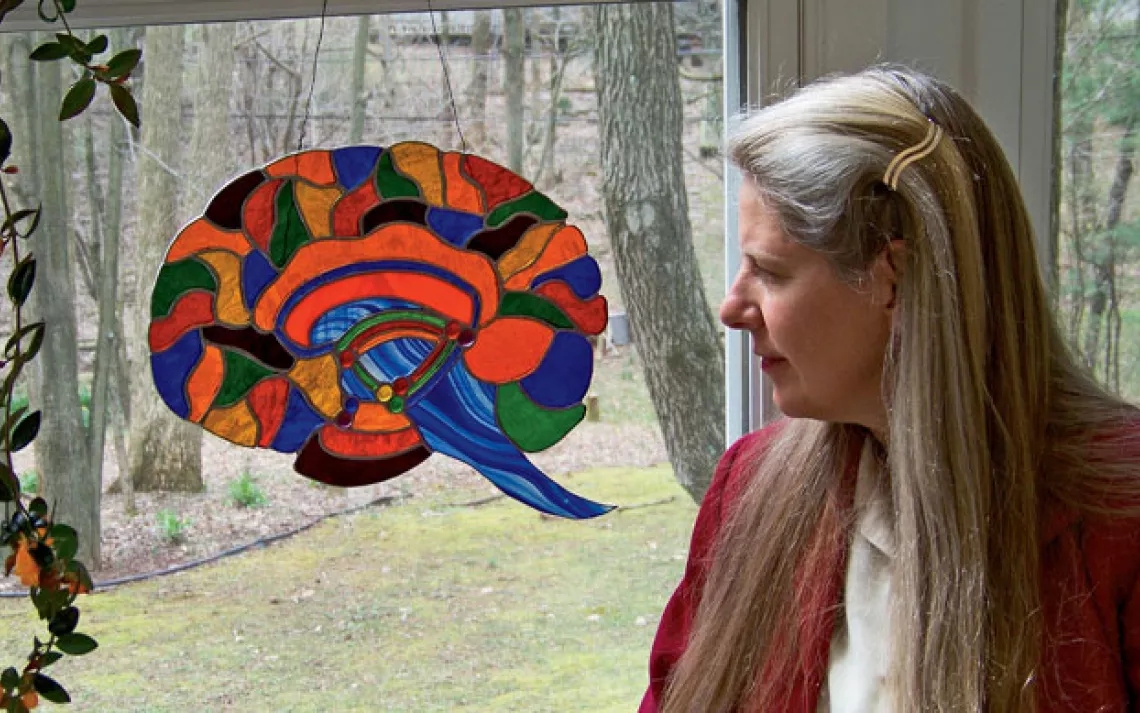
Who can credibly describe Nirvana? The monk, the meditator, the psychonaut, the near death experiencer, or, perhaps unexpectedly, the scientist who suffered a stroke? Whatever the reason, they each report a transformative feeling of equanimity, gratitude, and connectedness.
Among these reports, there is none quite like Jill Bolte Taylor’s.
Jill wasn’t seeking Nirvana. It found her when an artery exploded in her left brain – disabling her rational analytical mind and leaving her in a sublime state of peace she’d never felt before.
As a neuroanatomist PhD, she pondered the impact of her stroke in real-time…
Jill experienced “Nirvana” – deep relaxation and relief – while simultaneously being aware she would die unless she went to a hospital. Miraculously, she did, and over the course of eight years, rebuilt her rational analytical mind from scratch.
Her major insight? All of us can find this peace.
Two Brains
A major premise of her story, well established outside her book, is our two brains.
In the words of Iain McGilchrist, arguably the world’s expert on brain hemispheres, our left brain is narrow, focused, and grasping. It abstracts, categorizes, manipulates, and seeks certainty and control. In contrast, our right brain is broad, open, relational. It perceives context and meaning. It’s attuned to ambiguity, nuance, and connection.
Jill further describes the left brain here:
“One of the jobs of our left hemisphere language centers is to define our self by saying “I am.” Through the use of brain chatter, your brain repeats over and over again the details of your life so you can remember them. It is the home of your ego center, which provides you with an internal awareness of what your name is, what your credentials are, and where you live. Without these cells performing their job, you would forget who you are and lose track of your life and your identity.”
When Jill’s “ego centered” left brain was damaged, her usual “self” went quiet. She felt enveloped in warmth and peace. Granted, without her ego-based rational analytical side, she couldn’t function normally, and was entirely dependent upon caregivers. Initially she didn’t want to go back to normal life. But gradually her resolve and motivation became clear:
“In order for me to choose the chaos of recovery over the peaceful tranquility of the divine bliss that I had found in the absence of the judgement of my left mind, I had to reframe my perspective from “Why do I have to go back?” to “Why did I get to come to this place of silence?” I realized that the blessing I had received from this experience was the knowledge that deep internal peace is accessible to anyone at any time. I believe the experience of Nirvana exists in the consciousness of our right hemisphere, and that at any moment, we can choose to hook into that part of our brain. With this awareness, I became excited about what a difference my recovery could make in the lives of others-not just those who were recovering from a brain trauma, but everyone with a brain!”
Tending Our Mental Garden
Eight years after her stroke, Jill rehabilitated her left brain and resumed life as a conference speaker and advocate for brain research.
Importantly, however, she “pruned back” the more bossy, invasive, ego-centered parts of her mind. Because she inhabited a place of peace, she was very sensitive when aspects came online that she didn’t want, e.g. anger, impatience, and snap judgement.
Jill notes we have more control over thoughts and feelings than we realize:
“As biological creatures, we are profoundly powerful people. Because our neural networks are made up of neurons communicating with other neurons in circuits, their behavior becomes quite predictable. The more conscious attention we pay to any particular circuit, or the more time we spend thinking specific thoughts, the more impetus those circuits or thought patterns have to run again with minimal external stimulation.”
Jill compares our mind to a garden:
“Regardless of the garden I have inherited, once I consciously take over the responsibility of tending my mind, I choose to nurture those circuits that I want to grow, and consciously prune back those circuits I prefer to live without. Although it is easier for me to nip a weed when it is just a sprouting bud, with determination and perseverance, even the gnarliest of vines, when deprived of fuel, will eventually lose its strength and fall to the side.”
While Jill’s advice is backed by neuroplasticity principles, it feels simple and familiar:
“To experience pain may not be a choice, but to suffer is a cognitive decision.”
“If you have lost your ability to experience joy, rest assured the circuitry is still there. It is simply being inhibited by more anxious and/or fearful circuitry. How I wish you could lose your emotional baggage, just like I did, and shift back into your natural state of joy! The secret to hooking into any of these peaceful states is the willingness to stop the cognitive loops of thought, worry, and any ideas that distract us from the kinesthetic and sensory experience of being in the here and now.”
“Peacefulness should be the place we begin rather than the place we try to achieve.”
Left vs Right Balance
Returning to Iain McGilchrist, rather than consider ourselves as “left-brained” or “right-brained,” he urges us to recognize both capacities within ourselves and to cultivate a healthy relationship between them. He describes the right hemisphere as the “Master” and the left as the “Emissary”, noting that trouble arises when the emissary usurps the master. At the same time, he emphasizes that the two depend on each other’s strengths.
Jill Bolte Taylor seems to embody this idea.
Summary
Jill’s story is uniquely powerful because of its spontaneous nature and her related expertise. While anyone can describe Nirvana, Jill’s experience is underpinned by her understanding about the brain and mind, with a major emphasis on how malleable it is.
Just as it doesn’t take terminal cancer to find the peace Roland Griffiths did, it doesn’t take a stroke to find the peace Jill Bolte Taylor did.
The full book is here:
Amazon Link
Public Library Link
Tending Toolkit
If our mind is a garden, Self-Investigation is a way to explore and tend to it. As we often say, there is no silver bullet. Some combination of metacognition/meditation, journaling, and diverse contemplation go a long way.
See The Practice.
Discussion
This is posted to reddit for voting and discussion.
When Brain Damage Creates Nirvana
byu/JesseNof1 inSelfInvestigation