
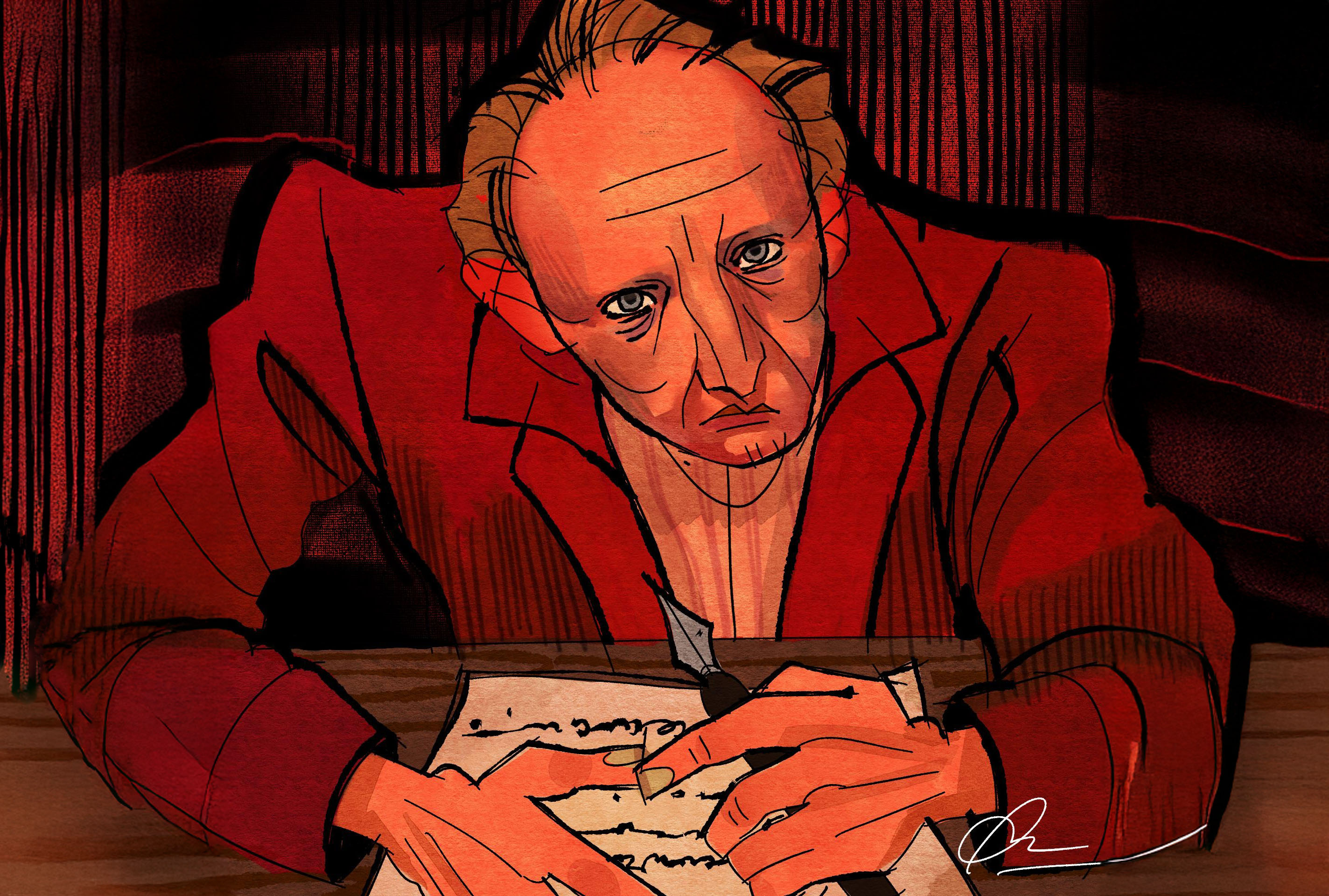
When does rationalizing go too far?
In the 17th and 18th centuries, the Enlightenment swept through Europe. It was a movement based on rationality – giving rise to science, individual rights, institutions, journalism, and new paradigms of governments and economies.
As Enlightenment momentum made its way to Russia, the 1863 book “What Is to Be Done?” imagined a utopian society. This prompted Fyodor Dostoevsky to wonder:
Where is rationality trying to take us?
He explores this through a fictional man who lives underground.
Notes from Underground – Part I
The book begins with a narrator who is spitefully holed-up in his home. He’s middle-aged and doesn’t get out much. He sees everyone in the world and their actions as stupid.
“I repeat, I repeat with emphasis: all ‘direct’ persons and men of action are active just because they are stupid and limited. How explain that? I will tell you: in consequence of their limitation they take immediate and secondary causes for primary ones, and in that way persuade themselves more quickly and easily than other people do that they have found an infallible foundation for their activity, and their minds are at ease and you know that is the chief thing.”
The narrator is saying if people actually took the time to think more rationally about their lives, they wouldn’t do half the things they do. He differentiates himself from these so called men of action he sees in the world around him for their capacity to act on base impulses.
“[The man of action] rushes towards his goal like an enraged bull with lowered horns, only a wall can stop him… I am green with envy at such a man… a genuine, normal person, just as mother nature wished to see him… Perhaps a normal person is supposed to be stupid.”
At the same time, he appears to resent himself. His intelligence causes a sort of paralysis…
“Now, I am living out my life in my corner, taunting myself with the spiteful and useless consolation that an intelligent man cannot become anything seriously, and it is only the fool who becomes anything.”
He then acknowledges the limits of reason:
“Reason is an excellent thing, there’s no disputing that, but reason is nothing but reason and satisfies only the rational side of man’s nature, while will is a manifestation of the whole life, that is, of the whole human life including reason and all the impulses.”
This admission by the narrator is significant. While he’s obsessed with the idea of rationality, he recognizes it is only one side of human nature. As someone who has prioritized rationality in guiding his life and actions, the narrator admits to feeling somehow unnatural or out of touch.
“…the antithesis of a normal man, that is, a man of overly acute consciousness, who emerged, of course, not from the bosom of nature but from a laboratory test tube… [he] considers himself not as a person, but as a mouse.”
In summary, the narrator’s fixation with rationality leaves him trapped in his home and trapped in his thinking – ridiculing the masses from a safe distance. He praises intellect while simultaneously pointing out its limits:
“All these theories for explaining to mankind their real normal interests, in order that inevitably striving to pursue these interests they may at once become good and noble—are, in my opinion, so far, mere logical exercises!”
He’s rationalized himself into a corner – both figuratively and literally. How did this happen?
Notes from Underground – Part II
The narrator recounts two major episodes from his youth:
Dinner with “Friends”
The first episode involves a scene with former schoolmates, whom he both despises and envies. Despite these judgements, he longs for their validation, and awkwardly invites himself into a farewell dinner they were planning without him. Before the dinner he spends several days obsessively planning how to appear superior.
The event itself is humiliating. His friends start the dinner by bonding with each other. He participates awkwardly, lashes out, and leaves feeling degraded. Rather than learning from the experience, his humiliation fuels even deeper resentment, clinging to his sense of moral and intellectual superiority as compensation for social failure.
Love and Liza
The second episode concerns Liza, a young prostitute he meets at a brothel. In a moment of emotional intensity, he delivers a speech about her dim future as a prostitute, appealing to her humanity out of genuine care. He wants her to dream of something more. He professes finding salvation in love. His harsh rational worldview seems to melt as he speaks from the heart. He invites Liza to visit him at his home.
Later, he dreads having opened up to Liza like that. When she shows up at his home, his vulnerability terrifies him. He becomes cruel – shaming her, asserting dominance. Yet she remains there, listening to him, and at the emotional climax of the book something seems to give. She sees that underneath all of his hateful babbling is a heart in pain. For the first time in his life he is truly understood. He breaks down, and they embrace.
“I’d become so accustomed to inventing and imagining everything according to books… But here’s what happened: Liza, insulted and crushed by me, understood much more than I had imagined… she understood first of all… that I myself was unhappy.”
Unfortunately, this was too much for the narrator to bear – this is the moment which sends him underground for good. He collapses back into self-loathing and sends her away.
Summary
In both episodes, the narrator’s emotional side forced him into vulnerable situations – seeking validation and seeking love. His rational side then fought back violently – punishing everyone including himself, until he was safely isolated once again.
Plot Summary
The narrator wants to live a life of intelligence and rationality. His emotions have different plans – forcing him to contradict himself in spectacular ways. In the long run, the only place to be free of contradiction is underground.
This serves as a warning against rationalizing parts of the human spirit that don’t want to be rationalized.
We can calculate ourselves into a perfect life, or calculate a perfect society – a “crystal palace” of logic, but deep down, the human spirit will mount extraordinary protest:
“Shower upon him every earthly blessing, drown him in a sea of happiness, so that nothing but bubbles of bliss can be seen on the surface; give him economic prosperity, such that he should have nothing else to do but sleep, eat cakes and busy himself with the continuation of his species, and even then out of sheer ingratitude, sheer spite, man would play you some nasty trick. He would even risk his cakes and would deliberately desire the most fatal rubbish, the most uneconomical absurdity, simply to introduce into all this positive good sense his fatal fantastic element. It is just his fantastic dreams, his vulgar folly that he will desire to retain, simply in order to prove to himself—as though that were so necessary—that men still are men and not the keys of a piano.”
According to Dostoevsky, what man wants above all is to be free.
If freedom means defying all logic out of spite, so be it.
Rationality has power, but when it cages the human spirit, the spirit will break the cage.
“What man wants is simply independent choice, whatever that independence may cost and wherever it may lead. And choice, of course, the devil only knows what choice.”
Contradictory Inner Worlds
A major point Dostoevsky captures is something we can all feel:
Our rational mind and emotional impulses can feel like contradictory inner worlds.
When rationality attempts to dominate rather than understand our impulses, it does not bring harmony – it provokes resistance, distortion, and spite. The narrator is not irrational because he lacks reason. He is irrational because he is divided against himself.
This warning is clear. But what does it look like from the inside – in us? Dostoevsky doesn’t hand us a practice, but he does hand us a problem we can investigate.
Self-Knowledge
In exploring the effects of this tyranny of the intellect we can examine the underground man’s inner world. Namely, in trying to rationalize every part of his life, he grew out of touch with his emotions and impulses. Then, in looking inward he was greeted by a jumbled mess and found no motivation act.
“Every man has some reminiscences which he would not tell to everyone, but only to his friends. He has others which he would not reveal even to his friends, but only to himself, and that in secret. But finally there are still others which a man is even afraid to tell himself, and every decent man has a considerable number of such things stored away. That is, one can even say that the more decent he is, the greater the number of such things in his mind.”
Going further, one sees how linked the questions of “Who am I?” and “What is to be done?” truly are. That is, like Albert Camus who wanted to live “without appeal,” or Sartre who warned of the dangers of “bad faith,” the underground man sought to answer the ultimate existential question of how one can live. Yet, without first coming to terms with all parts of his being, the underground man is unable to act whatsoever.
Aversion to Real Life
As a further consequence of this jumbled inner life, the narrator becomes averse to “real life”. He critiques and pokes fun at social formalities and is unable to make any sort of meaningful relationships with others. He thinks through the outcomes of all actions and and is unable to hold a job or really do much of anything.
“We’ve become so estranged that at times we feel revulsion for genuine ‘real life,’ and therefore we can’t bear to be reminded of it.”
In Albert Camus’ seminal work The Stranger, we see a protagonist, Meursault, who, like the underground man, is estranged from the world by his refusal to follow societal norms. And yet, where the underground man suffers and spirals as a result of this, Meursault seems to find freedom. While both characters are skeptical of the world, Meursault’s capacity to understand his feelings liberates him. Check out our more detailed work up on Camus’ The Stranger here.
Meditation
How can we appreciate these distinct inner worlds within ourselves?
Meditation asks us to sit and observe.
Observing isn’t rational, it’s simply observing, nothing more.
Classic meditation shows that the “thinking mind” is merely one aspect of mental life, the same as sights, sounds, emotions, pain, touches, etc.
Our thoughts can feel so immediate, so reliable, and so urgent, they feel irresistibly true. But from the meditative perspective, we can see them as pure mental phenomena, with no actual power to compel us. Thoughts are often quite flawed. The nonobvious thing about thoughts: we can discard them just as quickly as they arise. We don’t need to act on them.
In short, observing is a way to see both worlds without always engaging in them. This isn’t a permanent state or a final insight – just a different way of seeing that can be practiced.
Split-Brains
How does modern science show these worlds from the outside?
One (of many) clues is the fact that we have two brains – left and right. Although they are connected, they operate independently and have quite different dispositions. Research shows the left hemisphere is logical, works with abstractions, and breaks the world down into small chunks. The right hemisphere is intuitive and thinks globally.
And yet we are one person.
How do we know which brain is “speaking up” and when? This is a mystery. But at the very least, we can respect our multiplicity, as opposed to assuming we – our mind and behavior – are one coherent force. The evidence shows we are not.
Split brains don’t exactly explain “rationality” vs “impulses”, but they do show how our “intelligence” is actually a conglomeration of multiple inner intelligences – some thought based, some feeling based.
Reflection
First let’s respect this book for what it is: a warning against over-rationalizing – trying to calculate the perfect life or perfect society. Period.
Next, we can wonder about ourselves:
Why can our inner world feel so divided and contradictory?
We offer a couple threads to pull. We can start with meditation and cognitive science. Unsurprisingly, this line of inquiry easily snowballs into the entire landscape of Self-Investigation.
Discussion
This is posted to reddit for voting and discussion.
Notes from Underground
byu/JesseNof1 inSelfInvestigation