
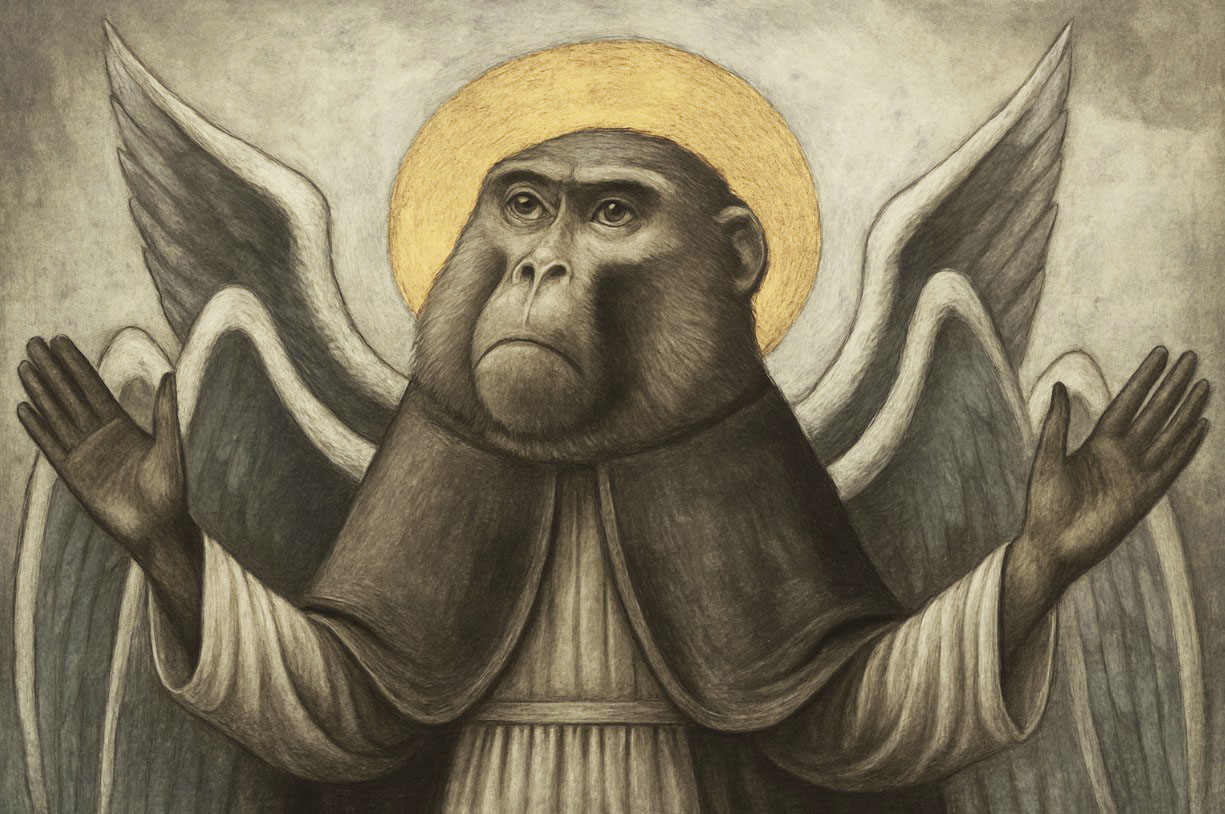
“You could never convince a monkey to give you a banana by promising him limitless bananas in monkey heaven.”
At first, this quote seems to pick on monkeys.
But it’s actually the opposite.
Humans do horrific things based on ideas alone. In an extreme example, ideological terrorists enthusiastically harm people, because they believe in supernatural rewards.
In contrast, monkeys, or most animals, operate only on naked reality in front of them. No “interpretation”, “myths”, or conceptual “spin” added that might drive their behavior.
Even if we aren’t terrorists, our lives are dominated by stories.
Stories touch nearly every aspect of how we interact with each other. This is not inherently good or bad. There are bad stories, based on fear and violence (i.e. radicalized religion), and there are good stories, based upon shared values and established trust (i.e. democratic government, money, laws).
“Story” does not mean “fake” – it merely means an abstraction – concepts that only exist between human minds – and yet have the power to control us.
Yuval’s point is this:
Stories to us, are like water to fish. We are so immersed in them, dependent upon them, it’s hard to see them for what they are. Stories are simultaneously our greatest power – the ability to cooperate at massive scales – on the order of millions or billions of people working toward a common goal. And they are also our greatest vulnerability – in that a story might be manipulative, divisive, dishonest, and serve an ulterior agenda or cause harm.
Addictive Stories Spread More Than Helpful Stories
“Memes are selfish, they will get copied, if they can. Some of them will be copied because they’re good, or true, or useful, or beautiful. Some of them will be copied even though they’re not. Some, it’s quite hard to tell why.”
The word “meme” was coined in 1976, long before the internet…
It simply explains how ideas replicate (like “genes”).
If I tell you something insanely interesting or funny, you will probably share it with other people. It might not even be true or helpful.
Given the internet’s mind-boggling volumes of content, and what its algorithms tend to amplify, it is worth considering what we’re seeing every day.
For an idea to spread, it merely needs to be attractive, not necessarily true, or worthwhile.
This is an unfortunate reality of how our brains tend to prioritize attention. Fear and anger are powerfully motivating emotions. This has been known since the early days of news broadcast and the expression “If it bleeds, it leads”.
Where Do Bad Stories Come From?
Our Brain
“The left hemisphere is extraordinarily good at making things up. In fact, it’s a bullshitter.”
Iain McGilchrist, Psychiatrist, Neuroscientist
Our brain creates them – even if they aren’t necessarily true. This is arguably the sneakiest part of mental life that we can’t easily see within. Our brain is a plausible story generating machine, but scientific research shows how frequently these stories aren’t true.
This is most obviously seen in split brain patients, but applies to all of us.
Malicious Actors
People create stories to deceive and exploit other people.
Dubious Facts
People create stories based on misunderstanding of facts. A fact, ideally, is something nobody can deny. But facts in society are denied regularly. What is actually true? What isn’t?
Reflection
Stories (or ideas, or concepts) are our superpower and our Achilles’ heel. When we consider them for what they are, they lose power over us.
We might better question their source and how trustworthy they are. This deepens appreciation for what “trust” actually is – how fragile it is – and how essential it is for civil society.
Further, we might pay more attention to the stories we regularly tell ourselves – the ideas about who we are – what people think of us – what we want – what we need. Where did these narratives come from? Who are we, apart from them? Are they true?
Finally, we might take routine breaks from ALL stories. This might mean being in nature, meditating, doing something artistic, or time spent in flow state. When our conceptual mind is quiet, who are we? How do we feel? What is life?
“To function in this world, you need to be an expert manipulator of thoughts and ideas. Our world is a conceptual world. This is what it means to be human. But this arena of concepts, it’s like a cloud, floating above above the immediate surface of what’s here.”
Discussion
This is posted to reddit for voting and discussion.
Life Is Storyland
byu/self-investigation inSelfInvestigation