
To appreciate how psychedelics support mind expansion and relief, we must first consider how our mind builds itself to begin with.
In essence, our brains are prediction machines. They absorb senses from across our body – sights – touches – smells – sounds – and combine that with memories to show “us” – consciousness – the world – and shape how we feel about it.
This is quite literally our personal reality – who we are – what we see – and the myriad of emotions and behaviors that arise as a consequence.
To illustrate this, we can use an analogy of Pavlov’s dog…
Pavlovian Conditioning

Pavlov famously trained dogs by ringing a bell and promptly giving them food. By doing this repeatedly, the dogs began expect food when hearing the bell and salivate, even if no food was present.
Our brains work similarly – except more extensively than bells and food.
Given a familiar sight, sound, experience, or complex social situation, our brains respond with a preloaded set of emotions, urges, and thoughts in response. It’s not as if we consciously choose these reactions. They arise on their own – subconsciously.
This complex history of stimulus and response is known as conditioning. To be a grown human is to have a thoroughly conditioned mind.
For the most part, conditioning is advantageous, it is the reason we move effortlessly through a vast a and complicated world. But our conditioning might sometimes work against us.
When Conditioning Goes Awry
What if our conditioned reality is unhelpful?
What if we regularly feel sad, stuck, overwhelmed, anxious, or exasperated.
In these cases, our brain may have memories of stimuli and response – known as “priors” – that run contrary to wellbeing. As if our brain is clinging to a pattern that doesn’t work – like Pavlov’s dogs – hearing a bell that betrays their hunger.
How would anyone relax their unhelpful priors, and possibly rewire them?
A Stuck Mind vs. A Free Mind
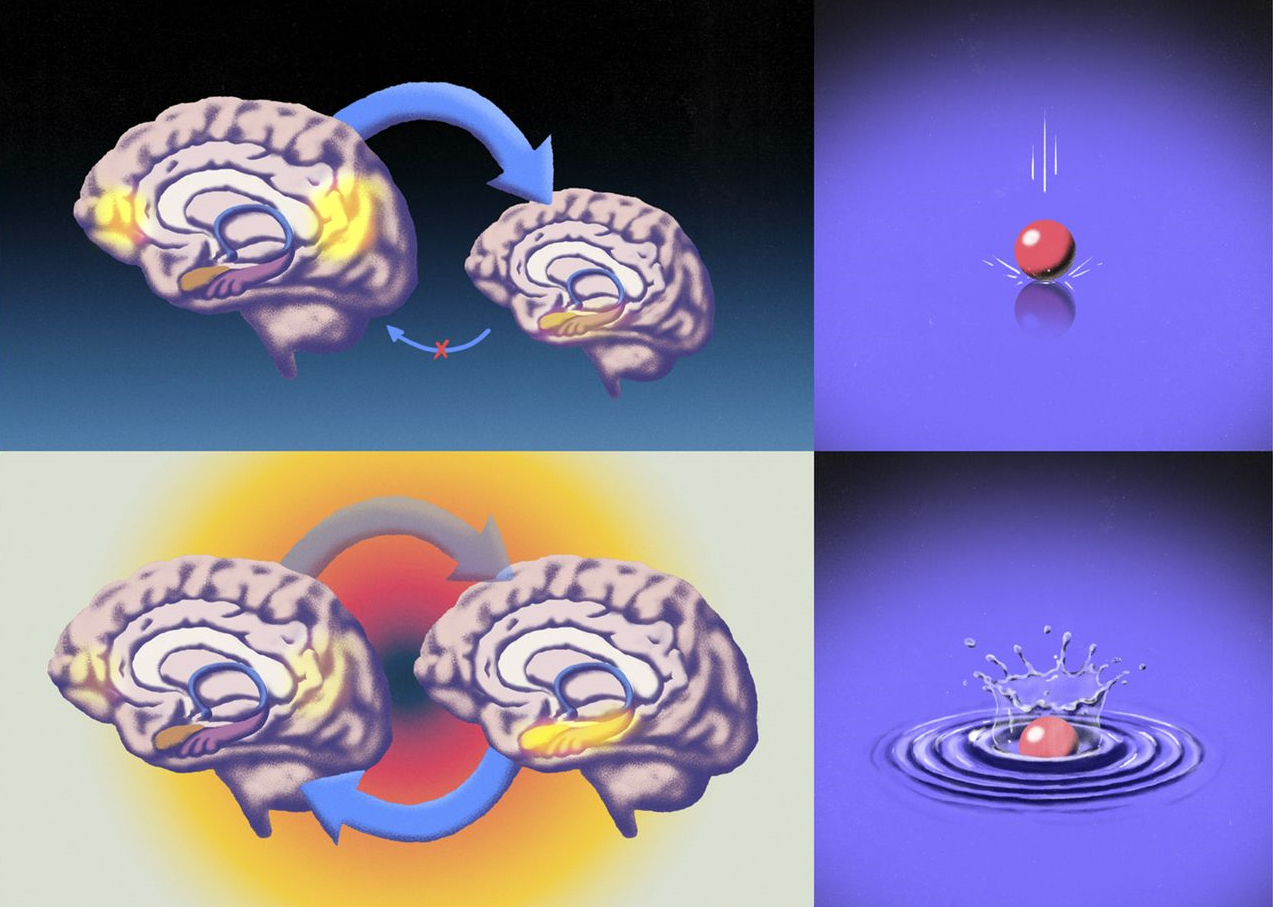
The following illustration (source) uses a red ball to symbolize sensory input absorbed by two different brains.
The top half of the illustration shows a brain rigidly “overweighting” its priors. In this scenario, new sensory input is largely hidden from consciousness, because the brain is tightly fixated on what it already knows. In a way, this brain is blind to fresh perspectives.

Conversely, the bottom half shows sensory input making a splash – or having a substantial influence upon consciousness, meaning, past experiences and expectations are challenged and recalibrated with fresh sensory input.
This does not mean strong conditioning is inherently good or bad…
Imagine an elite athlete or musician, performing effortlessly and subconsciously, after decades of rehearsal. In this case, conditioning is miraculous.
In the other hand, imagine feeling chronically unwell or apathetic toward life in general. In this case, a softening of perspective would potentially work wonders.
Psychedelics
So our brain generates reality based upon what it senses from the world in conjunction with our unique past experiences, or priors. Further, our brains are vulnerable to overweighting “priors” that aren’t necessarily helpful.
This is where psychedelics exhibit their famous and peculiar effect.
Psychedelics bind to the serotonin (5HT2A) receptors in our brain. This seems to, temporarily, disrupt and weaken the strength of “priors” in the brain. In other words, rather than relying heavily upon past experience to shape our reality, the brain allows fresh sensory input and forms new interpretations and assumptions.
With extreme doses, this disruption can be radical – visual hallucinations and entirely different notions of identity and reality.
With low doses, this disruption can be subtle.
In either case, from the first person standpoint, one briefly perceives their life from a new angle. This offers a differential – in other words – a frame by which to compare and contemplate life from – even long after the psychedelic experience is over.
A Non Psychedelic Equivalent
Of course, psychedelics aren’t the only way to relax priors.
In brain scans, long term meditators show similar activity as those using psychedelics. This is briefly touched upon by Roland Griffiths, below.
Meditation, sometimes called “Mindfulness”, is an extraordinarily powerful tool for introspection. Unfortunately, many people “bounce off” meditation, or never try it, as it can seem pointless, and tends to take time.
In contrast, psychedelics have this effect instantaneously. The intrigue is high, the effort is low, and the effects are essentially guaranteed.
Takeaways
It would be remiss to suggest psychedelics and meditation are interchangeable. Their properties and advantages are distinct. Yet, they appear to converge on similar insights in complementary ways.
A foundation in meditation likely helps orient to a psychedelic experience, whereas a psychedelic experience helps a meditator understand realms of consciousness that might be hard to comprehend.
Perhaps the greatest value of psychedelics, aside from using them, is revealing how our minds work to begin with. Psychedelics offer evidence of mental blindness as a consequence of strong conditioning, and suggest this situation is more malleable than we might suspect.
Responsible Use
Perhaps the most unfortunate aspect of psychedelics today, is several decades of stigma, restriction, and misunderstanding. Only recently has legitimate research substantiated the merits of psychedelics. Yet even now, we are years away from access for the average person – and the path is still contentious and uncertain.
However, for those who are willing to educate themselves, and explore responsibly, there are ways forward.
Although the power of psychedelics can be extraordinarily therapeutic, using them recklessly, in the wrong setting, with unclear intention, may set someone up for a bad experience. Psychedelics soften our minds and alter reality – which has equal potential for harm as it does good.
So long as this power is respected, the potential for harm can be greatly reduced.
Finally, again, it is helpful to regard psychedelics as merely one path up the mountain of self investigation. In this sense, they aren’t “essential”, and there are comparable ways to explore.
Consider the full landscape of self investigation here.
Leave a Reply