
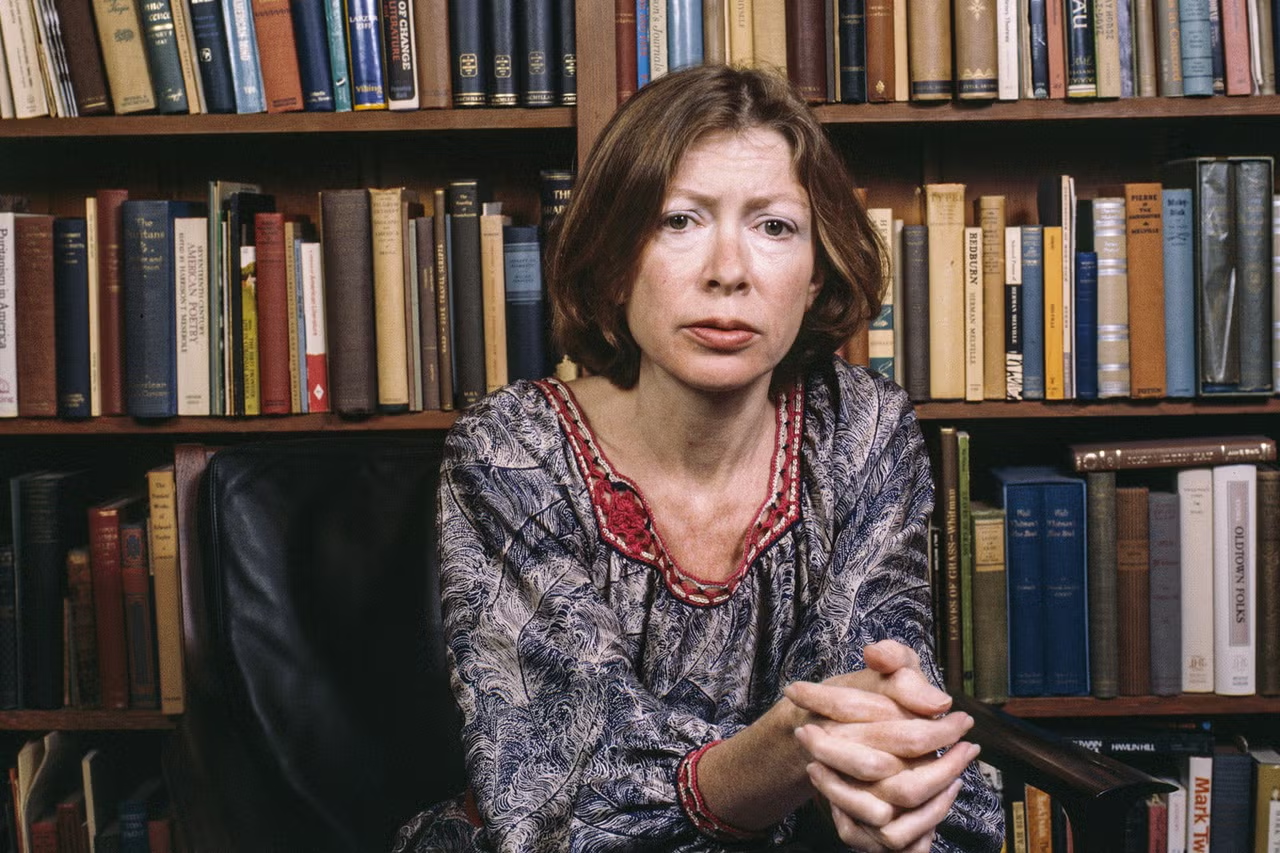
Joan Didion’s famous 1967 essay can be read many ways.
Superficially, it can be read as a statement about life in New York City. More carefully, it can be read as a story about naive fantasy, disenchantment, and moving on – which could just as easily have happened in “Paris, or Chicago, or even San Francisco”, in her words.
This essay evolves the more one reads it. At twenty-two it may feel like romance and invitation. At thirty-five it may feel like a diagnosis. Eventually it may feel like a lesson about contentment.
Even if we cannot relate to Didion’s exact circumstances, we can relate to suddenly seeing our own habits as strange and undesirable – and finding ourselves in loops that make us depressed. We are all vulnerable to this – not merely in youth but throughout our lives.
If we are lucky, we too find the clarity to say: “Goodbye to all that.”
We’ll explore her essay in three parts: fantasy, disenchantment, and moving on.
At the end we’ll consider what wisdom can be gleaned.
Fantasy
The essay begins when, at 20 years old, Didion moves from Sacramento to Manhattan. After leaving the airport, she excitedly gazes from the bus window to catch the city skyline, but instead sees a series of tunnels and road signs and a flood of rain. Finally she arrives at her small apartment, and takes in a view of the Brooklyn Bridge. (Which she later discovers, is the not-so-iconic Triborough bridge.)
For the next three days, she is wrapped in blankets with a bad cold and fever, in an apartment that was way too cold, but too timid to ask anyone to help, because she wondered, was she supposed to tip them? Funny how small obstacles can paralyze us in our most vulnerable moments.
Nevertheless, her exuberance was undeterred.
She remarks on her disposition in those days:
“One of the mixed blessings of being twenty and twenty-one and even twenty-three is the
conviction that nothing like this, all evidence to the contrary notwithstanding, has ever happened to anyone before.”
A world of infinite options and possibilities stood before her. It wasn’t long before she was immersed in it. While bouncing from one social scene to the next, she recalls a foretelling moment:
“I remember once, one cold bright December evening in New York, suggesting to a friend who complained of having been around too long that he come with me to a party where
there would be, I assured him with the bright resourcefulness of twenty-three, ‘new faces.’ He laughed literally until he choked, and I had to roll down the taxi window and hit him
on the back. “New faces,” he said finally, “don’t tell me about new faces.” It seemed that the last time he had gone to a party where he had been promised “new faces,” there had been fifteen people in the room, and he had already slept with five of the women and owed money to all but two of the men. I laughed with him, but the first snow had just begun to fall and the big Christmas trees glittered yellow and white as far as I could see up Park Avenue and I had a new dress and it would be a long while before I would come to understand the particular moral of the story.“
Her friend’s apathy was unfathomable to her!
She was in love with her city:
“I remember walking across Sixty-second Street one twilight that first spring, or the second spring, they were all alike for a while. I was late to meet someone but I stopped at Lexington Avenue and bought a peach and stood on the corner eating it and knew that I had come out of the West and reached the mirage. I could taste the peach and feel the soft air blowing from a subway grating on my legs and I could smell lilac and garbage and expensive perfume.”
Even her relative poverty felt mostly fine:
“I was making only $65 or $70 a week then, so little money that some weeks I had to charge food at Bloomingdale’s gourmet shop in order to eat. Making a living seemed a game to me, with arbitrary but quite inflexible rules. And except on a certain kind of winter evening – six-thirty in the Seventies, say, already dark and bitter with a wind off the river, when I would be walking very fast toward a bus and would look in the bright windows of brownstones and see cooks working in clean kitchens and imagine women lighting candles on the floor above and beautiful children being bathed on the floor above that – except on nights like those, I never felt poor; I had the feeling that if I needed money I could always get it. I could write a syndicated column for teenagers under the name “Debbi Lynn” or I could smuggle gold into India or I could become a $100 call girl, and none of it would matter.”
Despite any hardship and inconvenience, she was so obviously buoyed by limitless allure surrounding her:
“Nothing was irrevocable; everything was within reach. Just around every corner lay something curious and interesting, something I had never before seen or done or known about. I could make promises to myself and to other people and there would be all the time in the world to keep them. I could stay up all night and make mistakes, and none of it would count.”
At the same time, she confesses, everything felt very temporary:
“It never occurred to me that I was living a real life there. In my imagination I was always there for just another few months, just until Christmas or Easter or the first warm day in May. New York was no mere city. It was instead an infinitely romantic notion, the mysterious nexus of all love and money and power, the shining and perishable dream itself.”
Disenchantment
Eight years after moving to NYC, this contradiction between infinite possibilities and perishability collided. She describes when it dawned on her:
“I never bought any furniture in New York. I moved into a monastic four-room floor-through on Seventy-fifth Street. There was nothing at all in those four rooms except a cheap double mattress and box springs, ordered by telephone the day I decided to move. All I ever did to that apartment was hang fifty yards of yellow theatrical silk across the bedroom windows, because I had some idea that the gold light would make me feel better, but I did not bother to weight the curtains correctly and all that summer the long panels of transparent golden silk would blow out the windows and get tangled and drenched in the afternoon thunderstorms.
That was the year, my twenty eighth, when I was discovering that not all of the promises
would be kept, that some things are in fact irrevocable and that it had counted after all, every evasion and every procrastination, every mistake, every word, all of it.”
She begins to describe her exhaustion:
“I remember sitting in a lot of apartments with a slight headache about five o’clock in the morning. I had a friend who could not sleep, and he knew a few other people who had the same trouble, and we would watch the sky lighten and have a last drink with no ice and then go home in the early morning light, when the streets were clean and wet (had it rained in
the night? we never knew) and the few cruising taxis still had their headlights on and the only color was the red and green of traffic signals.”
“I remember one day when someone came to pick me up for lunch, and we both had hangovers, and I cut my finger opening him a beer and burst into tears, and we walked to a Spanish restaurant and drank Bloody Marys and gazpacho until we felt better.
And even that late in the game I still liked going to parties, all parties, bad parties, Saturday-afternoon parties given by recently married couples who lived in Stuyvesant
Town, West Side parties given by unpublished or failed writers who served cheap red wine and talked about going to Guadalajara, Village parties where all the guests worked
for advertising agencies and voted for Reform Democrats, press parties at Sardi’s, the worst kinds of parties.”
Much like Billy Joel in Piano Man – Didion absorbs the stories of everyone in her orbit – as they share tidbits of their lives, and lament about unfulfilled hopes and dreams.
Ironically, Didion admits she was slow to see the lesson:
“You will have perceived by now that I was not one to profit by the experience of others, that it was a very long time indeed before I stopped believing in new faces and began to understand the lesson in that story, which was that it is distinctly possible to stay too long at the fair.
I could not tell you when I began to understand that. All I know is that it was very bad when I was twenty-eight. Everything that was said to me I seemed to have heard before, and I could no longer listen. I could no longer sit in little bars near Grand Central and listen to someone complaining of his wife’s inability to cope with the help while he missed another train to Connecticut. I no longer had any interest in hearing about the advances other people had received from their publishers, about plays which were having second-act trouble in Philadelphia, or about people I would like very much if only I would come out and meet them. I had already met them, always.”
What was once the thrill of novelty became a haunting mirror of a life she didn’t want:
“There were certain parts of the city which I had to avoid. I could not bear upper Madison Avenue on weekday mornings (this was particularly inconvenient since I then lived just fifty or sixty feet east of Madison) because I would see women walking Yorkshire terriers and shopping at Gristede’s, and some Veblenesque gorge would rise in my throat. I could not go to Times Square in the afternoon, or to the New York Public Library for any reason whatsoever. One day I could not go into a Schrafft’s; the next day it would be Bonwit Teller.
I hurt the people I cared about, and insulted those I did not. I cut myself off from the one person who was closer to me than any other. I cried until I was not even aware when I was crying and when I was not, cried in elevators and in taxis and in Chinese laundries, and when I went to the doctor he said only that I seemed to be depressed, and should see a “specialist.” He wrote down a psychiatrist’s name and address for me, but I did not go.”
Moving On
Finally, Didion’s life takes a lucky turn. An offhand suggestion pulls her out of deep despair.
“I had never before understood what ‘despair’ meant, and I am not sure that I understand now, but I understood that year. Of course I could not work. I could not even get dinner with any degree of certainty, and I would sit in the apartment on Seventy-fifth Street paralyzed until my husband would call from his office and say gently that I did not have to get dinner, that I could meet him at Michael’s Pub or at Toots or Shor’s or at Sardi’s East. And then one morning in April (we had been married in January) he called and told me that he wanted to get out of New York for a while, that he would take a six-month leave of absence, that we would go somewhere.
It was three years ago that he told me that, and we have lived in Los Angeles since. I was very young in New York, and that at some point the golden rhythm was broken, and I am not that young any more. The last time I was in New York was in cold January, and everyone was ill and tired. Many of the people I used to know there had moved to Dallas or had gone on Antabuse or had bought a farm in New Hampshire. We stayed ten days, and then we took an afternoon flight back to Los Angeles, and on the way home from the airport that night I could see the moon on the Pacific and smell jasmine all around and we both knew that there was no longer any point in keeping the apartment we still kept in New York.”
Lessons From the Fair
Didion’s essay is a cautionary tale for many reasons. Perhaps most striking is the insidious nature of her crippling despair – how it crept up silently for years and finally broke her. The very thing that drew her to New York – infinite novelty – was the thing that was hollowing her out – and she couldn’t recognize it.
At the start of the essay, she teases how she was paralyzed to ask for help when the air conditioning was too cold. At the end of the essay, she is paralyzed by a silent depression that had been accumulating for reasons she didn’t see or understand. A deep psychological problem that lightened only years after gaining distance.
Again – it is tempting to see this essay as merely a case of being young, and stupid, and reckless. A rite of passage we all experience and grow out of. However, more carefully, we see the root of Didion’s despair is her chronic pursuit of endless possibilities “just around the corner”. Wildly satisfying until she realized she was “staying too long at the fair”.
This is what we are all vulnerable to our entire lives: mindlessly following routines that we’ve long outgrown.
Expectations Versus Reality
Self-Investigation asks us to examine who we are.
In turn, we must examine what we do with our time. And why?
Many times in life, we enter into relationship with things: a place to live, a job, a romantic partner, a hobby, a belief system, or dreams of success. Often the long-term effects of these relationships play out much differently than we expected.
In the honeymoon phase – there is thrill – and some baseline pleasure or allure that holds us there. Often that turns to disenchantment, at which point we might ask, do I try to squeeze more out of this situation? Or does something fundamental need to change?
If we are very honest about our behaviors, what we expect from them, and how they affect us, do we like what we see?
Knowing When to Say Goodbye
This feels like the hardest part. Hindsight is 20/20.
In Didion’s case, her husband had a hunch to take a break from the city, which turned out to be massively important for her wellbeing. If that suggestion hadn’t come, how much more would she have suffered?
It is amazing how we cannot see the forest through the trees – that is to say – we cannot see how our own routines can make us suffer. Instead we see that the problem has to do with outside circumstances – how people, places, and things are failing to fulfill us or leaving us crying in moments of silence for no apparent reason. We might wait for those outside circumstances to change rather than looking within ourselves.
Not that goodbye is always the answer. Goodbye can be selfish. Goodbye can be a way to avoid problems we don’t want to deal with. Goodbyes have consequences we have to live with. The point is not that leaving is right – it’s that we should be the ones deciding, with our eyes open, rather than waiting for a crisis or luck to decide for us.
Goodbye to What?
When Didion finally said “Goodbye”, to whom, or what, was that directed? Was it really New York City? Or was it a part of herself she no longer related to? The physical move may have been a catalyst, but Didion’s relationship to the “fair” was forever changed.
Didion says herself that her story could have happened anywhere. The city was never the entire problem. The problem was an appetite that became a personality – one that could only feel alive on the way to something else. That appetite is what she left behind. Los Angeles just happened to be where she noticed it was gone.
Less Is More
A big question has lurked throughout this article: What do we need to be content?
Didion’s despair was caused by more – more faces, more parties, more possibility. What finally relieved it was taking all of that away, arrived at by accident.
To the rest of us – we don’t need to wait for despair. We do not need to wait for a lucky accident to give us perspective. We can run the experiment ourselves. Pick something we do to sustain happiness – large or small – and remove it for a while. A habit, a scene, a screen, a standing commitment, a story we tell about what we need. Then watch. Was it a need, or a fair we had stayed at too long?
Often, saying goodbye is much more liberating than we imagine, even if it means letting go of the familiar. Didion’s essay reminds us of this – and invites us to find out.
“It is easy to see the beginnings of things and harder to see the ends.”
Joan Didion