
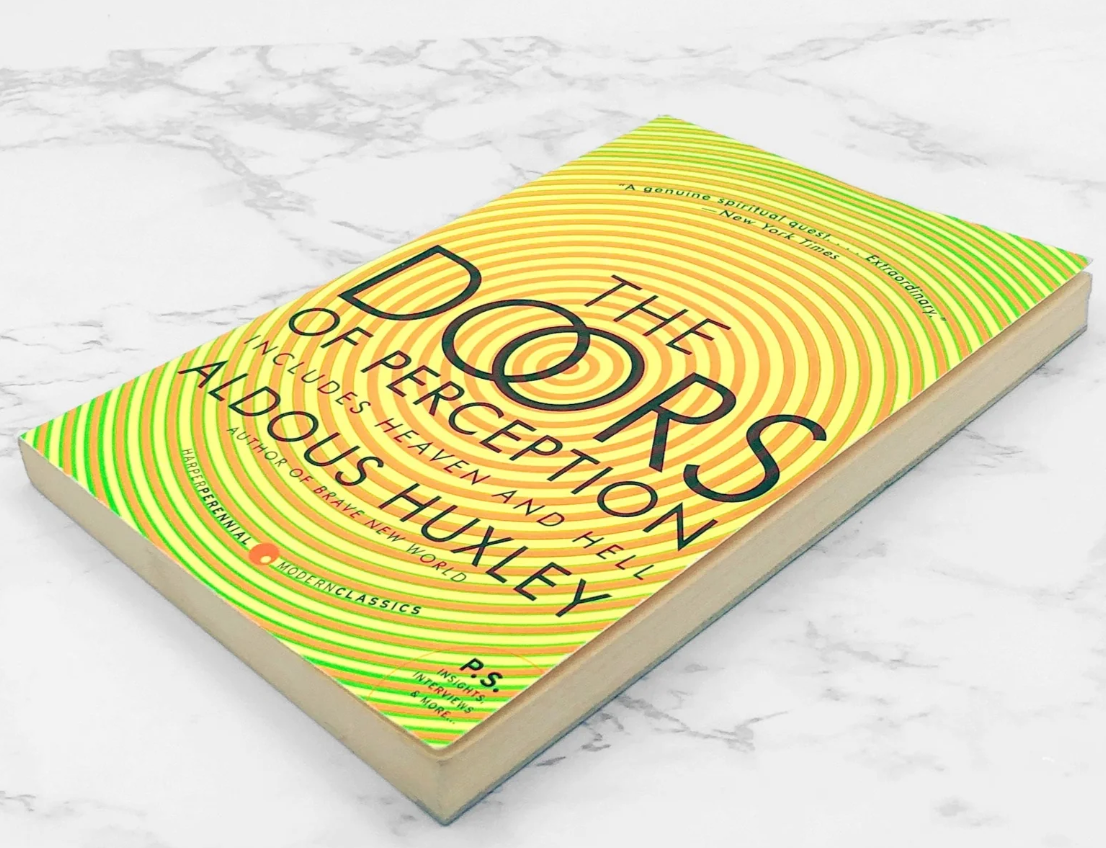
Our minds are relentlessly molded. To Huxley, the “inestimable” value of psychedelics is stepping outside that mold, even if only briefly.
Doors of Perception
In 1954 psychedelics were gaining attention in U.S. culture, but very little was known about them. Aldous Huxley, an accomplished author, volunteered to try mescaline and write about his experience.
While so much about psychedelics has been demystified since 1954, Huxley’s impressions remain apt, and many of his hunches have been affirmed by modern research.
Below are the major themes of his report.
Presence and Absorption
Arguably the strongest aspect of Huxley’s experience was his absorption and fascination with his immediate surroundings. His usual preoccupations with life, future, and past, were seemingly silent – allowing his full mental bandwidth to perceive with vivid clarity.
Everyday things that might normally seem mundane – e.g. the way the sun bounces off objects, the beauty of a flower, or the structure of chair, began to pop vibrantly.
”From the French window I walked out under a kind of pergola covered in part by a climbing rose tree and in part by laths, one inch wide with half an inch of space between them. The sun was shining, and the shadows of the laths made a zebra-like pattern on the ground. I was so completely absorbed in looking, so thunderstruck by what I actually saw, that I could not be aware of anything else.”
“‘This is how one ought to see,’ I kept saying as I looked down at my trousers or glanced at the jeweled books in the shelves, at the legs of my infinitely more than Van-Goiania chair.
Those folds in the trousers—what a labyrinth of endlessly significant complexity! And the texture of the Grey flannel—how rich, how deeply, mysteriously sumptuous!”
Unlike other mind-altering substances – Huxley felt quite “sober” while experiencing this, and wondered why normal life comparatively feels so dominated with what we “ought” to be doing… as opposed to appreciating the way things are.
“(With mescaline) the mind was primarily concerned, not with measures and locations, but with being and meaning. And along with indifference to space, there went an even more complete indifference to time.”
“How could one reconcile this timeless bliss of seeing as one ought to see with the temporal duties of doing what one ought to do and feeling as one ought to feel?”
Art and Artists
Huxley felt this “richer” world was always available, but our brain seemingly filters out too much of it. He mused that some people, such as artists, experience aspects of this unfiltered world more easily.
“What the rest of us see only under the influence of mescaline, the artist is congenitally equipped to see all the time. His perception is not limited to what is biologically or socially useful.”
He cites Van Gogh’s painting, “The Chair”. Although he concedes any painting will be “inadequate” to really show direct reality, this “mad painter” was seemingly on Huxley’s mescaline wavelength.

“It was on Van Gogh, and the picture at which the book opened was The Chair. That astounding portrait of a Ding an Sich, which the mad painter saw, with a kind of adoring terror, and tried to render on his canvas. But it was a task to which the power even of genius proved wholly inadequate. The chair Van Gogh had seen was obviously the same in essence as the chair I had seen.”
The Brain as a Reducing Valve
It wasn’t just Huxley’s visual world that was expanded with mescaline, but also his thoughts, feelings, and sense of self.
Reflecting on this, Huxley saw the brain’s main job as helping the human animal survive – which doesn’t necessarily lend itself to perceiving full reality. This intuition is consistent with modern theories of cognition and consciousness. (ref)
“To make biological survival possible, Mind at Large has to be funneled through the reducing valve of the brain and nervous system. What comes out at the other end is a measly trickle of the kind of consciousness that will help us to stay alive on the surface of this particular planet.”
Self-Transcendence
Huxley felt transcending our normal sense of “self”, and walking through this clearer “door of perception” is what we all yearn for deep down.
“Most men and women lead lives at the worst so painful and at the best so monotonous, poor, and limited that the urge to escape, the longing to transcend themselves if only for a few moments, is and has always been one of the principal appetites of the soul.”
Whether or not this appetite is indeed universal, it stands that anyone’s self-perception is prone to become narrow or overdetermined by past experience (ref), and therefore, to such a person, expanding (or transcending) it is potentially life-changing.
The Bottom-Line Value of Psychedelics
Our minds are relentlessly molded by society, symbols, language, and everyday human affairs. To Huxley, the “inestimable” value of psychedelics is stepping outside that mold, even if only briefly.
“To be shaken out of the ruts of ordinary perception, to be shown for a few timeless hours the outer and the inner world, not as they appear to an animal obsessed with survival or to a human being obsessed with words and notions, but as they are apprehended, directly and unconditionally, by Mind at Large—thus an experience of inestimable value to everyone and especially to the intellectual.”
”Systematic reasoning is something we could not, as a species or as individuals, possibly do without. But neither, if we are to remain sane, can we possibly do without direct perception, the more unsystematic the better, of the inner and outer worlds into which we have been born.”
”When we feel ourselves to be sole heirs of the universe, when ‘the sea flows in our veins… and the stars are our jewels,’ when all things are perceived as infinite and holy, what motive can we have for covetousness or self-assertion, for the pursuit of power or the drearier forms of pleasure?”
Extra Discussion
Low-Moderate Dose
Notably, in contrast with typical psychedelic lore, Huxley’s experience feels relatively gentle – i.e. no wild hallucinations or extreme loss of reality. This supports the idea that lower doses have distinct value, independent of high or macro / “heroic” doses. Psychologist James Fadiman at Harvard, frequently speaks about the value of low dose psychedelics. (ref, ref)
Psychedelics Legalization
Although academic research has essentially proven the merit of psychedelics for mental health (ref), psychedelics remain illegal in the United States, with clinicians and regulators still forging a path toward legalization. Although psychedelics are non-toxic, their psychological impact, if used recklessly or without support, can lead to difficult experiences.
Set, Setting, and Context
Famously, “set and setting” (mindset, intention, mood, and the external environment) are crucial to using psychedelics effectively, as opposed to recreationally without any defined purpose or safe environment. This precedent – of creating the ideal conditions – is very old – dating back to Native American rituals, and continuing all the way through to modern research settings.
This raises a key question:
What is a useful set, setting, and context, for the average person to explore psychedelic benefits effectively and safely?
While there is no universal answer, the general aim of “Self-Investigation”, and the related foundational skills such meditation and metacognition, seem to apply here.
In other words, to know ourselves is a journey that can be approached from numerous angles, and anecdotally, psychedelics, in conjunction with other Self-Investigation practices, seem uniquely revelatory. (ref)
Discuss
This is posted to reddit for voting and discussion.
Doors of Perception
byu/JesseNof1 inSelfInvestigation